Author: xtower

  • Strategic Realignment through Civil-Military Infrastructure Investments: Implications for Global Power Balances and Financial Markets

    Strategic Realignment through Civil-Military Infrastructure Investments: Implications for Global Power Balances and Financial Markets

    The defining feature of 21st-century geopolitical competition is the race to control dual-use infrastructure—systems that serve both civilian and military purposes. Whether in telecommunications, space-based assets, transportation corridors or energy networks, major powers are deploying civil-military infrastructure investments as instruments of long-term strategic influence.

    This strategy is reshaping global power balances, rewriting supply-chain dependencies and redirecting capital flows toward firms positioned at the nexus of technology, security and national resilience.

    1. Civil-Military Infrastructure as a Lever of Geopolitical Influence

    Unlike conventional military assets, civil-military infrastructure is subtle, persistent and deeply embedded in the daily operation of global commerce.
    Examples include:

    5G and secure telecom ecosystems controlling data flows,

    satellite constellations governing navigation, intelligence and logistics,

    energy and smart-grid networks linking regions through dependency chains,

    transport, port and undersea cable infrastructure shaping mobility and communication.

    Control over these systems allows states to exercise influence without escalation—deterring rivals, shaping regulatory standards and constructing long-term technological dependence.

    China’s Belt and Road infrastructure programs, the U.S.-Japan-Australia Blue Dot Network, and Europe’s Global Gateway all reflect this civil-military logic.

    2. 5G Networks: Infrastructure as Strategic Architecture

    5G systems, at their core, are command-and-control infrastructures underpinning both civilian industry and modern military operations.

    Nations that secure dominance in 5G architecture can:

    set cybersecurity norms,

    constrain rivals’ access to telecom supply chains,

    shape digital trade frameworks,

    and preserve intelligence superiority through secured data channels.

    This has spurred massive capital reallocation toward telecom-security firms and network integrators capable of providing trusted infrastructure, especially in Indo-Pacific democracies seeking alternatives to Chinese vendors.

    3. Satellite Constellations: Space as the New Geoeconomic Platform

    Low-Earth orbit constellations like Starlink, China’s GW system, and Europe’s IRIS² illustrate how satellite networks have become the backbone of both military operations and commercial connectivity.

    Their dual-use functions include:

    secure battlefield communications,

    autonomous vehicle navigation,

    maritime and logistics routing,

    agricultural and climate monitoring.

    The rapid scaling of satellite infrastructure has turned space-tech firms into high-value geopolitical assets, drawing investment from sovereign funds and defense-focused capital pools.

    4. Energy Grids and Critical Mineral Supply Chains: Powering Influence

    Energy infrastructure—especially LNG terminals, hydrogen networks, offshore wind grids and rare-earth supply chains—has become a battleground for strategic leverage.

    Countries investing in cross-border energy grids gain:

    political leverage over dependent states,

    insulation from geopolitical shocks,

    preferential investment inflows into strategic sectors.

    Military-origin technologies, such as hardened grid-control systems and cyber-secured SCADA architectures, increasingly underpin these networks.
    Their adoption enhances supply-chain resilience and attracts long-horizon institutional capital seeking safe harbors amid geopolitical volatility.

    5. How Capital Markets React: Premiums for Strategic Infrastructure Firms

    Global investors are placing premiums on companies integrating dual-use infrastructure capabilities.

    Capital markets show three clear patterns:

    (1) Reallocation toward resilient infrastructure assets

    Firms providing secure telecom, energy and space-based infrastructure outperform broader market indices in periods of geopolitical tension.

    (2) Surge of state-backed financing

    Governments are co-investing in civil-military infrastructure firms, offering procurement guarantees and subsidy frameworks that de-risk private investment.

    (3) Rising valuation of “strategic enablers”

    Cybersecurity vendors, satellite operators, semiconductor foundries and grid modernizers receive capital inflows typically associated with high-growth tech sectors.

    The message to investors is clear:
    Strategic infrastructure is the new frontier of global competition—and a new source of return.

    6. Supply-Chain Dependencies Rewired

    Civil-military infrastructure alters supply-chain maps by creating:

    trusted corridors (U.S.–Japan–Australia),

    contested corridors (South China Sea, Arctic routes),

    dependency corridors (energy networks, digital infrastructure).

    These dependencies determine:

    pricing power,

    investment risk profiles,

    corporate expansion strategies,

    long-term geopolitical exposure.

    Firms embedded within secure infrastructure ecosystems benefit from lower geopolitical risk premiums, while those reliant on rival-controlled systems face capital outflows.

    Conclusion: A New Geoeconomic Doctrine

    Civil-military infrastructure has emerged as a core strategic asset, redefining global power dynamics and financial-market behavior.
    Nations that control dual-use networks—5G, satellites, energy grids, secure cables—gain disproportionate influence over the world’s economic arteries.

    For investors, this marks the rise of geostrategic capital allocation: capital flowing not merely to efficient markets, but to secure markets.

  • Impact of Military-Grade Cybersecurity Innovations on Global Capital Markets and Supply Chain Resilience

    Impact of Military-Grade Cybersecurity Innovations on Global Capital Markets and Supply Chain Resilience

    The modern economy is being reshaped not only by supply-chain fragility but by the rising intensity of hybrid warfare—a domain where cyberattacks, disinformation, and infrastructure disruption converge. As states adapt, military-grade cybersecurity technologies—once confined to classified defense networks—are rapidly permeating global commercial supply chains.

    This migration is transforming investor behavior, infrastructure valuation, and capital allocation patterns across global markets.

    1. Hybrid Warfare Turns Cybersecurity into a Strategic Market Indicator

    Supply chains are no longer assessed purely on cost efficiency; they are rated on vulnerability to foreign cyber intrusion. Military-origin tools—including behavioral anomaly detection, zero-trust architectures, quantum-resistant cryptography and autonomous network defense systems—are now embedded in:

    logistics platforms,

    semiconductor fabs,

    financial clearinghouses,

    energy transmission systems,

    maritime shipping networks.

    The shift is driven by the realization that cyber weaknesses are national vulnerabilities, and national vulnerabilities depress capital markets.

    Countries in the Indo-Pacific, EU and North America now treat cybersecurity standards as macro-financial stability indicators.

    2. Commercial Supply Chains Move Toward Defense-Level Frameworks

    Corporations are adopting systems once reserved for defense agencies:

    AI-driven threat hunting trained on battlefield cyber data,

    satellite-linked redundancy networks safeguarding maritime trade,

    quantum-hardened encryption layers between critical industrial nodes,

    autonomous cyber-defense bots capable of isolating hostile code in seconds.

    This defense-to-commercial transfer reduces operational risk and raises confidence that supply chains can remain functional even during geopolitical crises.

    As a result, firms demonstrating robust cyber architecture benefit from:

    lower insurance premiums,

    higher valuation multiples,

    increased access to long-horizon capital.

    3. Investor Confidence Shifts: Cybersecure Infrastructure Outperforms

    The capital markets are rewarding companies that integrate military-grade cybersecurity because investors understand that hybrid threats—especially those from state-sponsored actors—are now permanent features of the global landscape.

    Key investment trends include:

    Infrastructure funds overweighting cyber-hardened utilities,

    Sovereign wealth funds backing defense-tech cybersecurity platforms,

    Private equity reallocating toward supply-chain security enablers,

    Capital flight from vulnerable sectors lacking critical cyber protections.

    Cyber resilience has become a valuation driver.
    Weak cybersecurity is now treated similarly to weak liquidity or poor governance: a red flag.

    4. Capital Flows Redirect Toward Firms Protecting Strategic Infrastructure

    Defense-tech companies providing commercialized cybersecurity solutions are experiencing a surge in:

    cross-border investment,

    joint ventures with energy and telecom giants,

    multi-year procurement contracts,

    government-backed financing frameworks.

    The market recognizes that digitally insecure supply chains cannot survive an era of strategic competition.
    Therefore, firms offering:

    quantum-resilient communication,

    autonomous cyber-defense systems,

    military-grade monitoring of industrial networks

    are becoming anchors of next-generation infrastructure portfolios.

    5. The New Reality: Cybersecurity = Supply Chain Survival

    Hybrid warfare has created a world where:

    Supply chains are not only physical but increasingly digital battlegrounds.

    Military-grade cybersecurity is no longer a defense-sector commodity; it is a global economic necessity.

    Companies securing critical infrastructure are receiving capital inflows normally reserved for high-growth technology sectors. Their role is shifting from “IT expense” to strategic backbone of national resilience.

    Conclusion: A New Investment Doctrine for a New Era

    The proliferation of defense-origin cybersecurity tools across commercial supply chains marks a structural evolution in global markets.
    Cyber resilience is now synonymous with economic resilience.

    Capital flows will continue to favor firms that fortify supply chains against hybrid threats. Those who fail to adapt risk being priced out—not by competitors, but by the security expectations of global investors.

    SockoPower | Defense-Tech & Strategic Intelligence
    Where technology, warfare and global markets converge.

  • Emerging Civil-Military Dual-Use Technologies Driving Strategic Autonomy in Indo-Pacific Supply Chains

    Emerging Civil-Military Dual-Use Technologies Driving Strategic Autonomy in Indo-Pacific Supply Chains

    The Indo-Pacific has become the world’s most contested technological theater, where military innovation and civilian industry are now inseparable. The region’s pursuit of strategic autonomy—the ability to secure economic value chains without dependence on geopolitical rivals—is increasingly driven by dual-use technologies originally developed for defense: AI-enabled sensing, quantum-secure communications, autonomous systems, resilient robotics and advanced semiconductor architectures.

    The convergence of defense and civilian innovation is not a future scenario. It is already rewriting the rules of supply-chain security, investment behavior and industrial strategy across the Indo-Pacific.

    1. AI: From Battlefield Decision Systems to Industrial Optimization

    AI began as a force-multiplier for ISR (intelligence, surveillance, reconnaissance) and autonomous targeting. Today, its dual-use expansion is transforming:

    maritime logistics and port automation,

    energy grid forecasting and resilience,

    aviation maintenance and predictive safety,

    financial risk modeling tied to supply-chain disruptions.

    Indo-Pacific governments increasingly view AI as a strategic asset, not merely a commercial tool. Nations such as South Korea, Japan, Australia and Singapore are integrating military-grade AI frameworks into commercial logistics networks to ensure continuity during geopolitical shocks—a concern heightened by Taiwan Strait tensions and the weaponization of trade routes.

    2. Quantum Computing: The Backbone of Future Supply-Chain Integrity

    Quantum technologies—particularly post-quantum cryptography and quantum key distribution (QKD)—were initially classified defense research.
    Now they are being rapidly deployed into civilian telecommunications and financial clearance systems across the region.

    Quantum integration enables:

    tamper-proof supply-chain authentication,

    secure semiconductor design collaboration,

    encrypted energy-grid command systems,

    high-fidelity modeling of rare-earth mineral extraction.

    As the U.S., Japan and Australia deepen quantum cooperation under AUKUS Pillar II, capital flows to quantum startups have surged, signaling a regional hedge against Chinese technological overreach.

    3. Autonomous Systems: Civilian Infrastructure Built on Military Logic

    Autonomous platforms—UAVs, maritime drones, robotic logistics vehicles—originated as battlefield tools. Today, they shape civilian sectors:

    offshore wind maintenance

    agricultural automation in Australia and Indonesia

    autonomous port operations in Singapore and Busan

    undersea mapping critical for submarine cables and energy pipelines

    These systems reduce vulnerability to chokepoints such as the South China Sea, enabling Indo-Pacific states to maintain operational continuity without foreign intervention.

    4. Supply-Chain Resilience: Dual-Use Technologies Become Strategic Shields

    The Indo-Pacific’s semiconductor reliance, rare-earth vulnerabilities and maritime exposure demand resilience that only dual-use technology can provide.

    New standards emerging include:

    defense-grade cybersecurity in private logistics,

    parallelized “critical tech corridors” bypassing conflict zones,

    AI-managed redundancy frameworks for semiconductor production,

    autonomous monitoring of submarine cable security.

    This shift is pulling institutional capital toward firms specializing in defense-grade AI, robotics, and quantum technologies—blurring the line between commercial and national-security sectors.

    5. Markets Respond: Capital Reallocates to Defense-Tech Innovators

    Regional capital markets—from Tokyo to Sydney to Seoul—are reweighting portfolios toward technology-driven defense firms.
    Drivers include:

    the need for supply-chain sovereignty,

    defense procurement modernization,

    public-private co-investment programs,

    and the recognition that civil-military convergence is irreversible.

    Companies able to demonstrate dual-use scalability—military-origin technology with commercial deployment potential—are becoming prime targets for global funds seeking exposure to Indo-Pacific resilience themes.

    Conclusion: The Indo-Pacific Is Building a New Industrial Doctrine

    Civil-military dual-use technologies are no longer supplementary components of national strategy—they are the central infrastructure of Indo-Pacific security and economic competitiveness.

    AI, quantum and autonomous systems will define which nations can maintain sovereignty, protect value chains and attract long-term capital.
    The region’s future will belong to states and companies that can deploy military-born innovations at industrial scale, constructing supply chains that are self-reliant, intelligent and geopolitically resilient.

    SockoPower | Defense-Tech & Strategic Intelligence
    High-end analysis for a world entering techno-geopolitical competition.

  • Emerging Civil–Military Technology Convergence and Its Impact on Global Power Projections

    Emerging Civil–Military Technology Convergence and Its Impact on Global Power Projections

    The 21st-century battlefield is increasingly shaped not by tanks, missiles, or aircraft, but by technologies originally developed for civilian markets—AI, autonomous robotics, satellite-enabled communications, and quantum computing. What once existed as separate technological domains is converging into a single, dual-use ecosystem where civilian innovation directly fuels military capability.

    This civil–military fusion (CMF) is fundamentally reshaping global power projection, particularly among the United States, China, and Russia.
    The nations that dominate dual-use technology pipelines will shape the future of deterrence, conflict, and geopolitical hierarchy.

    1. Dual-Use Innovation Has Become the New Arms Race

    Commercial tech is now military infrastructure.

    Artificial intelligence, advanced chips, hyperscale cloud computing, and high-speed mobile networks were never designed as weapons. Yet they now form the backbone of:

    autonomous drones

    AI-enhanced ISR (intelligence, surveillance, reconnaissance)

    predictive logistics

    cyber operations

    hypersonic command systems

    multi-domain operational networks

    The line separating Silicon Valley startups from defense contractors has vanished.

    The military of the future is built on commercial innovation.

    2. AI and Autonomous Systems: The Core of Next-Generation Power Projection

    Autonomy = speed. Speed = dominance.

    AI-driven autonomous systems—from drone swarms to automated cyber defense—are redefining military decision cycles.

    United States

    DARPA’s ACE program for AI dogfighting

    Navy’s Ghost Fleet Overlord autonomous vessels

    Joint All-Domain Command and Control (JADC2) integration

    China

    Civil–military fusion doctrine accelerating dual-use AI

    Mass production of low-cost autonomous drone platforms

    Strategic AI labs built on commercial tech giants (Baidu, Alibaba, Tencent)

    Russia

    Autonomous loitering munitions

    AI-assisted artillery targeting using battlefield sensors

    Heavy reliance on civilian drones modified for warfare

    Autonomy compresses the “OODA loop”—observe, orient, decide, act—creating a new currency of military advantage: machine-speed warfare.

    3. 5G/6G and the Battle for Electromagnetic Dominance

    Connectivity itself becomes a weapon.

    Modern militaries depend on massive data throughput:

    drone swarm coordination

    satellite–ground communication

    real-time logistics

    command-and-control

    autonomous navigation

    5G enabled this shift; 6G will accelerate it to near-lightning levels.

    U.S. strategy:

    Integrate 5G/6G into secure battlefield networks, leveraging private-sector leadership.

    China’s strategy:

    Use global 5G/6G infrastructure as geopolitical leverage, embedding influence across Asia, Africa, Europe, and Latin America.

    Russia strategy:

    Focus on electronic warfare dominance rather than broad consumer networks.

    5G/6G is not just commerce—it is information dominance, the foundation of modern power projection.

    4. Quantum Computing and Secure Communications: The Coming Strategic Shock

    Quantum supremacy will rewrite cyber warfare.

    Quantum technology threatens to disrupt the core of national security:

    encryption cracking

    ultra-secure quantum communication networks

    quantum-enhanced sensing for submarine and stealth tracking

    new forms of electronic warfare

    China

    Has already deployed a quantum communication backbone between Beijing and Shanghai, and runs the world’s most aggressive national quantum program.

    United States

    Leads in private-sector quantum computing hardware and algorithms (IBM, Google, AWS), with growing DoD–industry integration.

    Russia

    Invests in quantum sensing and signals intelligence capabilities.

    Quantum capability gaps will determine strategic survivability in the next decade.

    5. The U.S.–China–Russia Triangular Tech Rivalry
    Global power is no longer measured in troops but in teraflops.

    United States: Innovation Dominance Strength: advanced semiconductors, cloud infrastructure, AI algorithms, defense integration. Vulnerability: manufacturing dependence on East Asia.

    China: Scale + State Alignment

    Strength: mass production, civil–military fusion, unified national tech strategy.
    Vulnerability: access to cutting-edge lithography and high-end chips.

    Russia: Asymmetric Tech Warfare

    Strength: electronic warfare, missile systems, cyber operations.
    Vulnerability: industrial capacity and sanctions.

    The convergence of civilian and military tech has turned this rivalry into a three-dimensional race across AI, chips, quantum, and communications.

    Conclusion — Civil–Military Technology Convergence Will Redefine Global Power

    The future of power projection will be determined not by traditional defense spending but by:

    the speed of innovation

    control of advanced chips

    access to global telecoms infrastructure

    quantum breakthroughs

    autonomous systems deployment

    Nations that dominate dual-use innovation pipelines will shape everything from deterrence to alliance structures.

    Civilian technology is now the battlefield.
    The global balance of power will be rewritten there.

    References

    CSIS. Civil–Military Fusion and Strategic Competition, 2024.

    RAND. AI-Driven Warfare and Autonomous Systems, 2023–2024.

    U.S. DoD. Emerging Technologies and National Defense Strategy, 2024.

    Chinese Academy of Sciences. Quantum Communication Progress Report, 2024.

    NATO CCDCOE. Multi-Domain Operations and 5G/6G Integration, 2024.

    Oxford Future of Humanity Institute. Dual-Use AI & Global Security, 2024.

  • Capital Market Flows as Indicators of Strategic Supply Chain Realignments

    Capital Market Flows as Indicators of Strategic Supply Chain Realignments

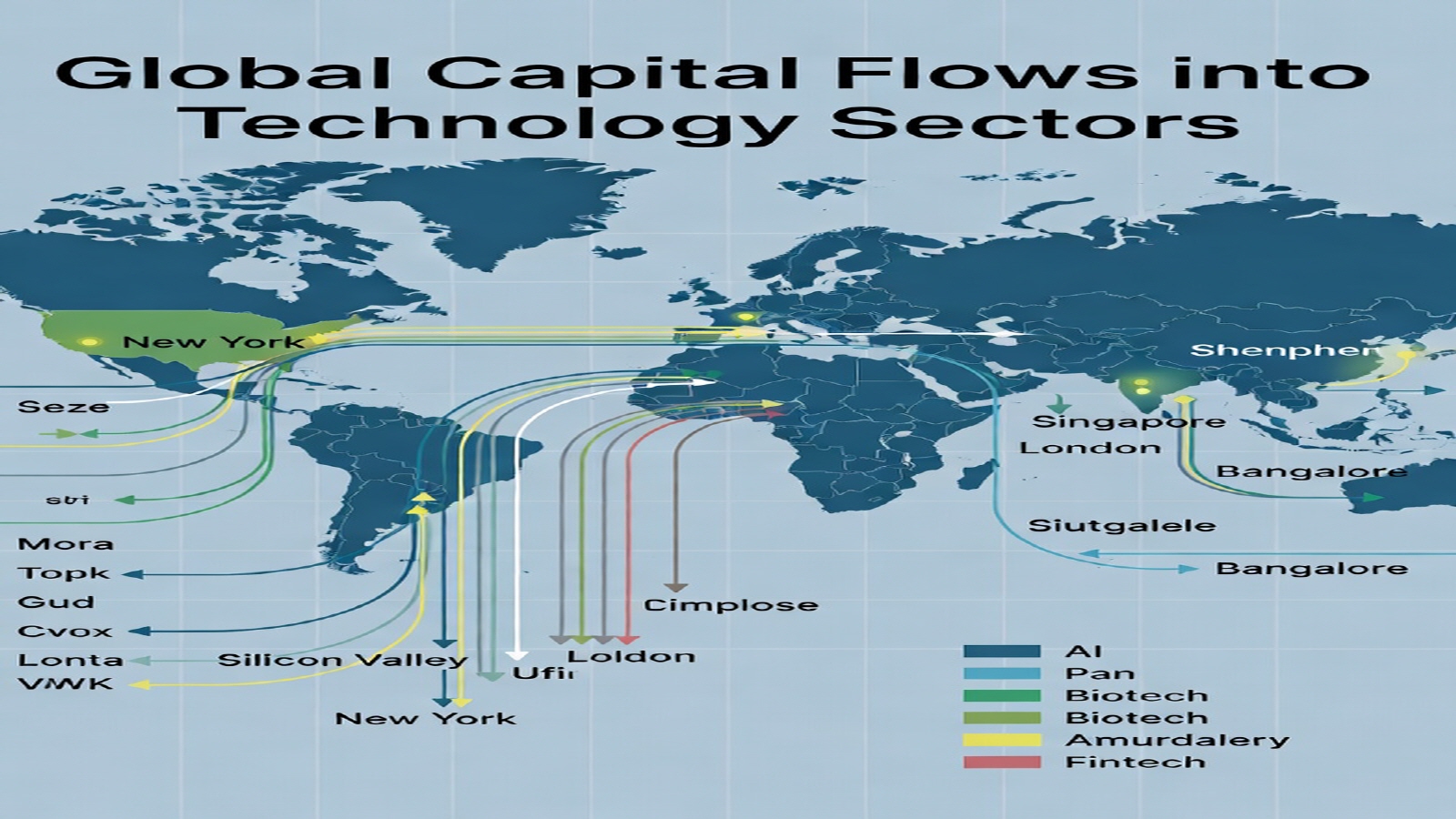
    Capital markets are no longer passive reflections of corporate performance—they have become real-time sensors of geopolitical strategy, especially in critical industries such as semiconductors, rare earth elements, defense manufacturing, and energy-transition materials. Shifts in cross-border capital flows now reveal where nations are tightening alliances, hedging against rivals, or preparing for supply chain decoupling. In a multipolar global economy, money moves first—policy follows, and industrial transformation comes last.

    1. Global Investment Flows as Strategic Early-Warning Signals

    Why capital moves before governments announce policy

    Fund flows, sovereign investment decisions, and private equity positioning are increasingly synchronized with geopolitical fault lines.
    Key global signals:

    Massive U.S. venture and defense-capital inflows into domestic semiconductor fabs

    Overall decline in Western capital exposure to China’s tech manufacturing

    India and Vietnam absorbing capital originally destined for Shenzhen, Suzhou, and Dongguan

    Energy-transition critical material funds shifting to Australia, Canada, and Latin America

    Sovereign wealth funds (GCC, Norway) reallocating from fossil-heavy portfolios to rare earths and advanced materials

    These flows collectively reveal a simple truth:

    Capital is repositioning itself in anticipation of a new global production architecture—not reacting to it.

    2. Semiconductors: The Leading Indicator of Geopolitical Alignment Investment flows prove that supply chain decoupling is real, not theoretical.

    Semiconductors represent the most telling alignment pattern:

    U.S. & Allies: Record-breaking investments in Arizona, Texas, Japan, South Korea

    China: State-driven capital expansion in domestic lithography, memory, and packaging

    Europe: Funding Germany, the Netherlands, and Eastern Europe as strategic redundancy hubs

    Private capital, sovereign funds, and government subsidies move together—identical direction, identical timing.

    This creates a triangular power structure:

    U.S.-led advanced-node coalition (TSMC/Japan/Korea)

    China’s self-reliant mass production ecosystem

    Europe’s resilience buffer

    The flow of money confirms that each bloc is building its own secure semiconductor orbit.

    3. Rare Earths & Energy Materials: Capital Flees Concentration Risk Diversification away from China is now irreversible.

    China still dominates rare earth processing, but global investment patterns show accelerating diversification:

    Australia: lithium, nickel, rare earth extraction

    Canada: critical minerals + independent refining capacity

    Chile & Argentina: lithium triangle surging investment

    Africa (Namibia, Tanzania): new rare earth mining hubs

    U.S. & EU: building refining capacity from scratch

    Western capital is no longer willing to tolerate single-point geopolitical fragility.

    These moves reveal a deliberate strategy:

    Break China’s chokehold without triggering direct confrontation.

    4. Energy Transition Capital: A New Geoeconomic Axis Battery supply chains are reshaping alliances.

    Follow the investment flows in batteries and energy materials, and you see the emerging geopolitical blocs:

    U.S.–Korea–Japan Battery Alliance grows rapidly

    Europe shifts toward domestic gigafactories

    China ramps up Belt-and-Road battery mineral control

    India emerges as a balancing force via massive cell and pack investments

    These flows define the 21st-century balance of power more than troop deployments or naval tonnage.

    Battery supply chain alliances are, effectively, political alliances in disguise.

    5. Decoupling, De-risking, and the Capital Geometry of Multipolarity
    Capital markets reveal the truth beneath diplomatic language.

    Governments publicly promise “de-risking, not decoupling.” But capital flows tell a different story: **capital is already decoupling**, especially in:

    critical tech

    data infrastructure

    rare earth refining

    semiconductor manufacturing equipment

    battery minerals

    This is silent decoupling, executed not by politicians but by investors.

    Money exposes geopolitical reality more clearly than diplomacy does.

    6. What Capital Flows Reveal About Emerging Power Structures

    A new configuration of global blocs is taking shape.

    Block A — U.S.-Aligned Industrial Coalition: Semiconductors, batteries, defense tech, critical minerals.
    Block B — China-Led Production Sovereignty Bloc 

    Mass-production ecosystem + mineral dominance + Belt-and-Road logistics.

    Block C — Strategic Middle Zone

    India, Vietnam, Indonesia, GCC:
    Not aligned to either side; leverage both.

    Block D — Resource Hubs

    Australia, Latin America, Africa:
    Become power brokers via mineral supply.

    Capital flows across these blocs show power is shifting from factories to minerals,
    from manufacturing hubs to capital allocators,
    from trade routes to investment routes.

    Conclusion — Capital Markets Are the New Geopolitical Map

    Capital flows are no longer background noise; they are the **master signal** of strategic realignment.

    They reveal where critical supply chains are migrating

    They expose emerging alliances long before treaties are signed

    They warn of decoupling before sanctions hit

    They show which countries will gain strategic leverage in the next decade

    If supply chains are the arteries of global power,
    ? capital markets are the heartbeat.

    Anyone tracking geopolitics without tracking capital flows is already behind the curve.
    SockoPower follows both.

    References

    • IMF. Cross-Border Capital Flows and Geoeconomic Fragmentation, 2024.
    • BIS. Financial Stability Review: Strategic Tech-Sector Capital Trends, 2024.
    • U.S. Department of Commerce. Semiconductor Investment Tracker, 2023–2025.
    • European Commission. Critical Raw Materials and Capital Allocation Report, 2024.
    • McKinsey Global Institute. Global Capital Rebalancing Amid Supply Chain Redesign, 2023.
    • CSIS. Strategic Decoupling and Industrial Capital Flows, 2024.
  • Supply Chain Vulnerabilities and Strategic Power Shifts in a Multipolar Global Economy

    Supply Chain Vulnerabilities and Strategic Power Shifts in a Multipolar Global Economy

    How Fragmented Production Networks Are Rewriting Global Power and Military Readine

    In the 21st century, supply chains have evolved far beyond commercial logistics. They now function as ‘sovereign assets’, and the ability to command or disrupt them directly shapes geopolitical leverage, military readiness, and the hierarchy of global governance. Accelerating protectionism, intensifying U.S.–China rivalry, and climate-induced disruptions are dismantling the old model of “low-cost, hyper-efficient globalization,” replacing it with a harsher system of strategic competition.

    1. The Fragmentation of the ‘Intermediate Goods World’

    Geopolitics has seized control of production networks.

    Over 70% of global trade consists of intermediate goods crossing multiple borders before reaching final assembly. This means that any disruption—anywhere—can immobilize entire industries.

    Recent shocks include:

    • U.S.–China semiconductor and AI export controls
    • Apple, Tesla, and major logistics firms accelerating “China-plus-one” exits
    • Red Sea attacks forcing up to 40% of container traffic to reroute
    • Grain and fertilizer shortages triggered by the Russia–Ukraine war

    The pattern is unmistakable:
    Geopolitical pressure has overtaken economic logic as the main driver of supply chain behavior.

    2. The Era of ‘Weaponized Supply Chains’

    States are now more powerful than multinational corporations.

    Where corporations once designed supply chains and governments merely regulated them, the power structure has flipped. Nations now treat supply networks as strategic weapons.

    United States

    • CHIPS and Science Act: semiconductors become defense infrastructure
    • Inflation Reduction Act: restructuring of minerals and battery supply chains
    • Integration of commercial and defense industrial bases for dual-use capability

    China

    • Export controls on rare earths, gallium, germanium, graphite
    • Use of strategic materials as diplomatic leverage
    • Expansion of South China Sea logistics and maritime choke-point control

    European Union

    • Critical Raw Materials Act
    • Diversification into Africa, Latin America, and the Arctic
    • Strategic autonomy efforts in energy, tech, and defense

    The result:
    Supply chain control has become a form of 21st-century coercive power—equal to sanctions, military bases, or currency dominance.

    3. Climate Change as an Emerging Military Variable

    Environmental instability now directly affects global force projection.

    Climate disruptions are no longer marginal. They increasingly degrade military mobility, energy logistics, and operational readiness.

    • The Panama Canal’s prolonged drought cut East–West shipping capacity
    • Middle Eastern and South Asian heat waves limit aircraft payloads
    • Melting Arctic routes are transforming the region into a new front for Russia, China, and NATO

    Climate instability is reshaping both commercial logistics and the strategic geography of warfare.

    4. Military Readiness Is Now Supply-Chain Dependent

    Wars are decided by throughput, not just firepower.

    The Ukraine war exposed how fast modern militaries burn through ammunition and components:

    • NATO’s artillery and missile stockpiles depleted far faster than expected
    • The U.S. drew on Korean and Japanese inventories to backfill shortages
    • China’s dominance in drones, batteries, and critical minerals highlighted its wartime industrial advantage

    The Pentagon now defines the defense industrial base as “the first line of deterrence.”
    A conflict can only last as long as the supply chain beneath it survives.

    5. Winners and Losers in the Multipolar Supply-Chain Order

    Real power is shifting—not through GDP, but through chokepoints and production sovereignty.

    United States

    Maintains global leadership via semiconductors, advanced manufacturing, defense production, and allied industrial coalitions.

    China

    Holds asymmetric leverage through rare earths, mid-stream manufacturing, and battery technologies—its “black-leverage” advantage.

    India & Southeast Asia

    Become the major beneficiaries of diversification away from China; new hubs for electronics, logistics, and heavy manufacturing.

    Japan & South Korea

    Strengthen their roles as indispensable nodes in semiconductors, batteries, shipbuilding, and next-generation defense systems.

    Multinational Corporations

    Transition from “stateless global actors” to politically constrained operators navigating sanctions, export controls, and alliance-based ecosystems.
    They no longer choose sites based on cost—but on geopolitical survivability.

    Conclusion — The State That Controls Supply Chains Controls the Future

    Economic, military, technological, and climate systems are merging into a single competitive domain. Power is no longer measured only by armies or reserves, but by the ability to reshape, protect, and weaponize supply chains.

    • Supply chains = peacetime leverage
    • Sanctions = wartime pressure
    • Chips & critical minerals = strategic sovereignty
    • Climate disruptions = force-projection constraints
    • Logistics realignment = the new map of global power

    In this multipolar era, the winners are the states and corporations that can rapidly reconfigure supply chains under pressure while maintaining technological and military resilience.

    This is the battlefield that will define global order—SockoPower is tracking it at the center of the map.

    References

    • Council on Foreign Relations. Global Supply Chain Pressure Index, 2023–2025.
    • U.S. Department of Defense. National Defense Industrial Strategy (NDIS), 2024–2025.
    • European Commission. Critical Raw Materials Act Briefing, 2024.
    • IMF. Geoeconomic Fragmentation and Supply Chain Resilience, 2024.
    • McKinsey Global Institute. Reimagining Supply Chains in a Fragmented World, 2023.
    • RAND Corporation. Industrial Base Dependencies and Military Readiness, 2024.
    • CSIS. Weaponized Interdependence in the Indo-Pacific, 2024.
  • Taiwan’s Home-Built Satellite Launch Taiwan’s First Home-Built Satellite Marks a Turning Point in the Global Civil-Military High-Tech Race

    Taiwan’s Home-Built Satellite Launch Taiwan’s First Home-Built Satellite Marks a Turning Point in the Global Civil-Military High-Tech Race

    Taiwan’s successful launch of its first fully home-built satellite—carried to orbit by SpaceX’s Falcon 9—signals far more than a technological achievement. It represents a strategic shift in the global civil-military innovation race at a moment when supply chain security, dual-use technology, and geopolitical resilience are becoming unavoidable priorities for governments worldwide.

    Named Chi Po-lin, the Formosat-8 satellite is the first in a planned constellation of eight Earth-observation platforms designed and manufactured domestically. While many countries still rely on external suppliers or lease commercial imaging services, Taiwan’s program demonstrates a decisive move toward indigenous high-tech autonomy. The satellite will orbit at 561 kilometers, collecting high-resolution data not only for environmental and urban-planning purposes but also for disaster response, climate monitoring, and national security applications.

    Leveraging local innovation pipelines, Taiwan’s space agency (TASA) reports that 84–86% of the satellite’s components were domestically manufactured—a milestone that dramatically reduces foreign dependency in an era of widening geopolitical uncertainty.

    But the deeper significance lies not in the technical details alone. Rather, Formosat-8 illustrates how small and mid-sized states are increasingly turning to dual-use space technologies to strengthen deterrence, upgrade national digital infrastructure, and build strategic resilience against external coercion. This shift echoes broader trends throughout the Indo-Pacific, where satellites, drones, AI-enabled sensing, and secure communications systems are reshaping both civil and military capabilities.

    Taiwan’s decision to build and deploy one satellite per year until 2031 will eventually create a sovereign, persistent surveillance network—allowing real-time environmental mapping, maritime domain awareness, and early warning capabilities. In practice, this means that critical information such as disaster zones, illegal fishing, covert military deployments, and gray-zone activities can be monitored without relying on foreign satellite windows.

    For an island under continuous geopolitical pressure, reducing vulnerability in the information supply chain is no longer optional—it is survival strategy.

    The launch also underscores the rise of commercial space actors as indispensable global partners. SpaceX, with its reliable and cost-efficient launch cadence, has effectively become the universal logistics backbone for emerging space nations. If a satellite fits in the payload bay, SpaceX will put it into orbit with unprecedented speed, allowing countries like Taiwan to compress development cycles and enter strategic orbits years ahead of schedule.

    This dynamic is accelerating a more fragmented yet innovative global space ecosystem. Nations with advanced semiconductor, manufacturing, and AI sectors—like Taiwan—are now using these strengths to enter the aerospace and defense space at a lower barrier of entry than in the past. Meanwhile, dual-use technologies are blurring the lines between civilian industry and strategic capabilities. A constellation designed for climate science can instantly become a national security asset; a commercial launch provider becomes a critical defense enabler.

    Taiwan’s achievement also fits into a larger Indo-Pacific trend: the rapid militarization of high-tech industries under democratic industrial policy. Japan, South Korea, Australia, and India are simultaneously expanding space reconnaissance programs, low-orbit communication networks, hypersonic research pipelines, and autonomous defense platforms. The region is heading toward a future where civilian innovation clusters—semiconductors, composites, robotics, photonics—power the next generation of deterrence architectures.

    China and Russia, meanwhile, are escalating counter-space programs, testing ASAT technologies, and integrating space-based ISR into joint operational planning. The United States continues to expand its Space Force and commercial launch ecosystem while encouraging allies to build capacity rather than depend on Washington alone.

    Against this backdrop, Taiwan’s satellite is more than a scientific tool; it is a sovereign digital shield.

    The Formosat-8 launch also demonstrates a strategic industrial truth: nations that build and control their own data infrastructure will dominate the next geopolitical era. Countries reliant on foreign satellite imagery, foreign cloud servers, or foreign supply chains will lack autonomy in crises. Taiwan’s approach—DIY innovation, domestic component manufacturing, and multi-year constellation planning—offers a roadmap for other small states seeking to build resilience in a contested world.

    In the realm of supply chains, Taiwan’s move strengthens its position as a high-tech manufacturing hub capable of integrating electronics, advanced materials, sensors, optics, and AI. The satellite program complements its semiconductor ecosystem, creating a vertically integrated dual-use industrial base aligned with U.S., European, and Indo-Pacific security interests.

    For global defense markets, this development is another indicator that the next decade will belong not only to superpowers but also to agile, technologically capable democracies building localized high-tech ecosystems. In space, as on Earth, speed, autonomy, and resilience increasingly outweigh sheer size.

    Taiwan’s new constellation is a warning shot to adversaries and a signal to allies: the era of small-state innovation powering big-state deterrence has arrived.

  • Counter-Drone Warfare at Scale — Why NATO’s New Multi-Layer Kill-Web Marks the Beginning of Cost-Dominant Air Defense.

    Counter-Drone Warfare at Scale — Why NATO’s New Multi-Layer Kill-Web Marks the Beginning of Cost-Dominant Air Defense.

    The future of air defense is no longer about billion-dollar systems shooting million-dollar missiles at improvised threats. Across NATO’s northern flank, militaries are rapidly shifting from platform-centric defense to sensor-centric kill-webs—distributed networks that merge commercial, military, and AI-enabled technologies into a single responsive grid.

    A major demonstration in northern Germany revealed something critical:
    ? NATO can now stand up a fully integrated counter-UAS ecosystem in days, not years.

    This shift signals a massive transformation in procurement, doctrine, and industrial supply chains—one that will define both battlefield survivability and defense sector investment priorities through 2030.

    1. A New Model: Low-Cost Kill Chains That Out-Scale the Threat

    Instead of shooting down $20k drones with $4M interceptors, NATO partners are adopting a layered approach:

    • AI-guided small arms with smart aiming modules

    Turns every soldier into an anti-drone node—effective against close-range FPV drones.

    • Net-launching interceptor drones

    Critical for urban environments and civilian areas where explosives are unacceptable.

    • Medium-caliber gun systems with automated tracking

    Bridges the gap between rifle-range and missile-range threats.

    • Open-architecture fusion of passive + active sensors

    A breakthrough:
    Passive radar that reads distortions in FM radio waves merged with active radar and EO/IR sensors—creating a resilient mesh that doesn’t depend on GPS or continuous emissions.

    Why this matters:
    Russia, Iran, and China are producing drones at industrial scale. Western militaries must counter mass with even cheaper mass, reinforced by real-time data.

    2. 3D Printing at the Tactical Edge — The Next Military Logistics Superpower

    One of the most strategically important demonstrations: a deployable 3D-printing tent producing operational drone frames within hours.

    Military impact:

    Enables on-demand replacement of attrited drones

    Supports custom drone geometries for local missions

    Removes bottlenecks from long-distance supply chains

    Allows rapid adaptation to evolving threat profiles

    This is not just convenience—it is logistics overmatch.

    In a future where drone attrition rates exceed 60–70% per mission, the side that can print faster and deploy faster wins.

    3. The Real Breakthrough: Sensor Fusion With Zero Latency

    For the first time, NATO demonstrated:

    • Seamless data-sharing across classification levels

    Classified → sensitive but unclassified → unclassified
    All in real time, with no latency penalties.

    • Multi-level dissemination

    Snipers

    FPV drone operators

    Mobile air-defense teams

    Unit commanders

    This is equivalent to taking the “JADC2 vision” and building a deployable version in a field in Germany.

    Strategic implication:
    NATO is building a kill-web that can function even without U.S. satellite or AWACS support—critical if American force posture shifts due to political or resource constraints.

    4. Europe Prepares for a Post-Assurance Era

    European officers attending the demo were interested in a simple question:

    “Can this stop Russian drone saturation attacks?”

    The answer—while not explicit—was implied:

    NATO is preparing Europe to defend itself even if U.S. support fluctuates.

    The technologies showcased are affordable at scale. They reduce  dependency on high-end U.S. platforms. They can be produced in Europe with COTS components. They operate without deep logistics chains

    This fits a broader trend:
    Strategic autonomy through distributed lethality.

    5. Economic and Industrial Implications for 2025–2030 Defense  manufacturers

    → Must pivot to modular open-systems architectures
    → Compete on cost-per-kill, not high-end specs

    AI companies

    → Battlefield sensor fusion is becoming a multi-billion-dollar market
    → Real-time edge compute for drone detection is critical

    3D-printing and advanced manufacturing sectors

    → Enter a new era as NATO tactically deploys additive manufacturing Investors.

    → Counter-UAS tech, AI-guided targeting, autonomous defense drones
    → Will outperform traditional aerospace segments in CAGR through 2030

    Geopolitics

    → Russia, China, and Iran accelerating low-cost drone proliferation
    → NATO racing to maintain defensive cost-dominance
    → Countries with strong electronics + additive manufacturing capacity gain leverage

    Bottom Line

    The Germany demonstration wasn’t a product expo. It was a strategic signal:

    NATO is shifting from legacy air defense to scalable, distributed, AI-enabled counter-drone ecosystems.

    This transition will define the next arms race — one centered on cost  efficiency, manufacturing agility, and information dominance.

    It’s not the end of traditional air defense. But it is the beginning of a new era where kill-web scale > platform power.

  • Strategic Decoupling & Supply Chain Fragmentation

    Strategic Decoupling & Supply Chain Fragmentation

    Geopolitics is no longer about territory — it is about who controls the technology stack that powers nations.

    The rivalry between major powers is pushing global supply chains toward fragmentation and regional tech ecosystems with distinct standards, components, and regulations.

    1. Export Controls as Strategic Weapons

    The U.S., EU, and Japan are restricting exports of:

    AI chips

    Quantum hardware

    Advanced lithography

    Military-grade sensors

    These controls slow adversaries’ military modernization and create two incompatible tech universes.

    2. China’s Push for Autonomous Tech Ecosystems

    China is accelerating domestic production of:

    Semiconductors

    UAV systems

    Rare-earth refining

    Advanced materials

    This reduces vulnerability to Western chokepoints while expanding influence across Belt-and-Road trade corridors.

    3. Indo-Pacific & European Realignments

    Nations caught in the middle are choosing sides based on:

    Defense treaties

    Trade dependencies

    Technology access

    Supply chain resilience

    This realignment is producing new economic blocs that operate on competing technical standards.

    4. Long-Term Impact

    Strategic decoupling will:

    Redesign global manufacturing

    Fragment digital trade

    Force companies to operate dual supply chains

    Increase geopolitical risk premiums

    The world is entering a period of permanent supply chain bifurcation.

    Bottom Line

    Civil-military tech competition is reshaping the global economy.
    Supply chains are no longer neutral — they are geopolitical assets.

    References

    WTO Global Value Chain Fragmentation Study

    U.S. Commerce Department Export Control Briefings

    EU Strategic Autonomy Framework

    Asia Pacific Foundation: Tech Bloc Formation Analysis

  • Capital Market Mobilization Behind Defense Innovation

    Capital Market Mobilization Behind Defense Innovation

    Capital markets have become an increasingly decisive battlefield in the race for technological superiority. Defense innovation is no longer driven solely by government budgets; instead, venture capital, sovereign wealth funds, and specialized defense-tech investment vehicles are now fueling advancements traditionally associated with national laboratories and military research agencies.

    In the U.S., venture funding for defense startups has surged as geopolitical instability and AI-driven military modernization expand commercial opportunity. Companies developing autonomous systems, cybersecurity platforms, secure chips, and space-based sensors are attracting record private capital.

    Sovereign wealth funds in the Middle East and Asia are also repositioning portfolios toward emerging military and dual-use technologies. Their long investment horizons make them uniquely suited to support capital-intensive innovations such as hypersonics, quantum communications, and next-generation energy systems.

    This mobilization of private and public capital introduces new competitive dynamics:

    Startups can now outperform legacy defense contractors in speed and adaptability.

    States with deeper capital pools can accelerate technological adoption faster than rivals.

    Financial flows themselves act as geopolitical instruments, shaping alliances and technology-sharing frameworks.

    As capital markets increasingly converge with defense strategy, the world is entering an era where financial influence directly shapes military power.

    References

    SIPRI Defense Economics Report

    PitchBook DefenseTech Funding Data

    CSIS Defense Industrial Base Analysis

    NATO DIANA Innovation Framework