Category: Insights

Public-sector signals translated into market-facing intelligence.

  • CPMI-IOSCO Targets Initial Margin Transparency in Centrally Cleared Markets

    CPMI-IOSCO Targets Initial Margin Transparency in Centrally Cleared Markets

    CPMI-IOSCO’s May 2026 consultation on initial margin transparency is not a technical footnote for clearing houses. It is a capital-market stability issue. The consultation targets updated guidance for central counterparties, or CCPs, and public quantitative disclosures that could make margin practices in centrally cleared markets more transparent, comparable, and easier to assess during periods of stress.

    The BIS Committee on Payments and Market Infrastructures and IOSCO published the consultation on May 6, 2026. They are seeking comments on proposed amendments to the 2017 CPMI-IOSCO CCP resilience guidance and the 2015 public quantitative disclosure standards for central counterparties. The consultation is intended to implement relevant proposals from the January 2025 BCBS-CPMI-IOSCO final report on transparency and responsiveness of initial margin in centrally cleared markets. Comments are due by June 30, 2026.

    For SockoPower’s Capital category, the key issue is simple: margin calls can become liquidity shocks. When market volatility rises, central counterparties may increase initial margin requirements. That can protect the clearing system, but it can also force clearing members and clients to find additional cash or collateral at exactly the moment when liquidity is already under pressure.

    That is why initial margin transparency matters. Market participants need to understand how CCP margin models behave, how responsive they are to volatility, and how changes in margin requirements could affect funding needs. If margin models are opaque, firms may be surprised by sudden calls for collateral. If disclosures are inconsistent, participants may find it difficult to compare risk across CCPs and clearing services.

    Shop strapless bras in a variety of sizes like 32AA, 34DD, and more. Find stick on bras, bras with removable straps \& more to go with open back dresses.

    The consultation is rooted in the market stress of March 2020. The CPMI-IOSCO cover note states that the earlier margining-practices review followed the Covid-19 market turmoil, which it described as the most significant test of financial market resilience since the 2007–09 Great Financial Crisis. That work examined whether margin calls in centrally and non-centrally cleared derivatives and securities markets were unexpectedly large and considered issues such as margin transparency, predictability, clearing member-client dynamics, and volatility.

    The proposed amendments focus on targeted additions rather than a new regulatory framework. CPMI-IOSCO states that the proposals are not intended to create additional standards beyond the Principles for Financial Market Infrastructures. Instead, they provide clarity on acceptable approaches to observing the PFMI, especially through updates to CCP resilience guidance and public quantitative disclosures.

    The core subjects include simulation tools, measurement of initial margin responsiveness, margin model governance frameworks, margin model overrides, and CCP public disclosures. These are not abstract details. They shape how market participants understand potential margin changes, how CCPs explain model behavior, and how supervisors evaluate the resilience of cleared markets.

    The public disclosure side is especially important for indexing and market transparency. The proposed amendments to the public quantitative disclosure standards would require more structured information around margin. The consultation material states that public quantitative disclosures are meant to help evaluate and compare CCPs, and it expects CCPs to publish disclosures in a common template, with reports available on the CCP’s website in an accessible format.

    Under the margin section, the proposed disclosure updates would require CCPs to report initial margin required at least at the level of each clearing service. They would also include different types of margin, such as baseline initial margin, add-ons, and retained mark-to-market or variation margin where relevant. Add-ons may reflect risks such as liquidity risk, concentration risk, correlation risk, wrong-way risk, or non-routine ad hoc intraday calls.

    That matters because not all margin is the same. A simple headline figure can hide whether margin pressure comes from routine baseline requirements, additional risk add-ons, intraday calls, or retained variation margin. Better disclosure helps participants understand the source of margin pressure and whether it is structural, episodic, or stress-related.

    The proposal also points to the need for more comparable margin information. CPMI-IOSCO acknowledges that margining practices vary across CCPs, which is precisely why standardized public disclosures matter. In a stress event, market participants and supervisors need to know not only that margin has increased, but why it increased, which clearing services were affected, and whether the data are representative of normal or stressed conditions.

    For capital markets, the signal is clear. CCPs are designed to reduce counterparty risk, but they can also concentrate liquidity demands. Initial margin is one of the places where risk protection and liquidity pressure meet. If disclosures improve, market participants may be better able to plan funding, manage collateral, compare clearing exposures, and anticipate stress-period liquidity needs.

    For SockoPower, this belongs in Capital because it sits directly inside the financial plumbing of markets. It affects derivatives clearing, collateral demand, liquidity planning, margin governance, and the transparency of institutions that stand between buyers and sellers in centrally cleared markets.

    The narrow takeaway is this: CPMI-IOSCO is trying to make initial margin practices more transparent before the next stress event, not after it. That is exactly the kind of capital-market infrastructure signal worth tracking.

    Original source

    Why It Matters

    This item may affect capital allocation because initial margin requirements influence collateral demand, clearing costs, funding pressure, and market liquidity. CPMI-IOSCO’s consultation on CCP resilience guidance and public quantitative disclosures aims to make centrally cleared initial margin practices more transparent and comparable, which matters when market stress increases margin calls.

    SockoPower Takeaway

    Initial margin is not just a clearing-house calculation. It is a liquidity transmission channel. When CCPs raise margin requirements during volatile markets, the effect can move through clearing members, clients, collateral markets, and funding conditions. The CPMI-IOSCO consultation matters because it targets the transparency layer behind that process.

    What to Watch Next

    Watch whether CPMI-IOSCO finalizes the amendments after the June 30, 2026 comment deadline.

    Watch how CCPs respond to expanded margin-related public quantitative disclosures.

    Watch whether market participants use the proposed disclosures to compare margin responsiveness across CCPs and clearing services.

    Watch whether future stress events show more predictable margin calls and fewer liquidity surprises.

    Watch how supervisors incorporate simulation tools, margin model governance, and margin model overrides into CCP resilience expectations.

    References

    BIS, “CPMI-IOSCO publishes for consultation updated guidance and public disclosures to support the implementation of initial margin proposals,” May 6, 2026.
    BIS CPMI, “CPMI-IOSCO consultation on updated guidance and public disclosures to implement initial margin proposals,” May 6, 2026.
    CPMI-IOSCO, “Consultation on updated guidance and public disclosures to implement initial margin proposals — cover note,” May 6, 2026.
    CPMI-IOSCO, “Public quantitative disclosure standards for central counterparties with proposed amendments,” May 2026.

    Socko/Ghost

  • WTO Technology Transfer Workshop Points to the Market Conditions Behind Industrial Capability

    WTO Technology Transfer Workshop Points to the Market Conditions Behind Industrial Capability

    WTO’s April 21, 2026 workshop on incentives for technology transfer to least-developed countries is not a defense technology story. It should not be presented as one. Its value for SockoPower is more precise: it shows the policy conditions under which technology transfer can move from a formal obligation into practical industrial capability.

    The workshop was opened by WTO Deputy Director-General Xiangchen Zhang and focused on incentives for technology transfer to least-developed countries. According to WTO, the discussion highlighted the enabling environment required for technology transfer to take root and deliver results in LDCs. That phrase is the key signal. Technology transfer is not only about moving patents, equipment, or technical documents. It depends on whether the receiving economy has the institutions, finance, skills, coordination, and private-sector participation needed to absorb and use the technology.

    The legal background is Article 66.2 of the WTO TRIPS Agreement. WTO materials describe this provision as requiring developed country members to provide incentives to enterprises and institutions in their territories to promote and encourage technology transfer to LDC members, with the purpose of helping them create a sound and viable technological base. This is important because the obligation is not framed only around governments. It explicitly points to enterprises and institutions as the channels through which technology transfer is expected to happen.

    For SockoPower’s Signal category, the issue is not whether this workshop directly commercializes military technology. It does not. The issue is whether global trade institutions are emphasizing the conditions that allow technology to become productive capacity. That is highly relevant to strategic industry, because dual-use and defense-adjacent technologies also depend on the same foundations: legal predictability, financing, human capital, institutional coordination, private firms, and absorptive capacity.

    The narrow signal is therefore this: technology transfer policy is shifting from formal reporting toward implementation conditions. WTO’s framing suggests that incentives alone are insufficient if the local environment cannot convert transferred knowledge into production, services, training, maintenance, adaptation, and commercialization.

    Shop strapless bras in a variety of sizes like 32AA, 34DD, and more. Find stick on bras, bras with removable straps \& more to go with open back dresses.

    That matters for private companies. A technology market does not emerge simply because a donor, government, or international body says a transfer should occur. It emerges when firms can access finance, protect and use intellectual property, hire or train technical workers, coordinate with public agencies, and sell products or services into a real market. Without those elements, technology transfer remains a reportable activity rather than an industrial result.

    This is where the topic connects to SockoPower’s broader concern with strategic commercialization. Military and dual-use technology markets are not built only by laboratories or defense ministries. They require suppliers, maintenance companies, software firms, testing services, certification pathways, financing channels, procurement signals, and export rules. The WTO workshop is not about that full defense chain, but it points to the same underlying principle: technology becomes power only when the enabling environment allows it to be absorbed and commercialized.

    The LDC context also adds an important caution. Technology transfer cannot be treated as a simple copy-and-paste process from advanced economies to developing economies. The receiving side must build what economists often call absorptive capacity: the ability to understand, adapt, operate, improve, and scale a technology. If that capacity is weak, even generous incentives from developed countries may produce limited industrial outcomes.

    For readers tracking strategic industry, the lesson is practical. When assessing any emerging market for advanced technology, the first question should not be only whether the technology is available. It should be whether the environment can turn that technology into a market. The WTO workshop highlights that the answer depends on law, finance, institutions, coordination, and private-sector engagement.

    Original source

    Why It Matters

    This item may indicate a new policy and technology direction worth watching because WTO’s discussion frames technology transfer as an ecosystem problem. Legal obligations and incentives matter, but technology becomes industrial capability only when finance, absorptive capacity, coordination, and private-sector participation are in place.

    SockoPower Takeaway

    Technology transfer is not a shipment. It is a market-building process. The WTO workshop matters because it points to the conditions that determine whether transferred technology becomes usable capability, commercial activity, and long-term industrial depth.

    What to Watch Next

    Watch whether developed WTO members report more concrete enterprise-level incentives under TRIPS Article 66.2.

    Watch how LDCs define their technology-transfer priorities in areas such as digital infrastructure, energy, health technology, agriculture, climate adaptation, and manufacturing.

    Watch whether private-sector participation becomes more central in future WTO discussions on technology transfer.

    Watch how “enabling environment” language is used in broader debates on strategic technology, dual-use commercialization, and industrial capability building.

    References

    WTO, “Technology transfer workshop highlights role of enabling environment in LDCs,” April 21, 2026.
    WTO Technical Assistance Management System, “Workshop on the implementation of Article 66.2 of the TRIPS Agreement: Incentives for Technology Transfer to LDCs.”
    WTO, “TRIPS Agreement — Article 66.”

    Socko/Ghost

  • Hyun Song Shin at the Bank of Korea: A Central Banker for an Age of Capital Stress

    Hyun Song Shin at the Bank of Korea: A Central Banker for an Age of Capital Stress

    The appointment of Hyun Song Shin as Governor of the Bank of Korea is not just another central-bank personnel change. It is a signal about the kind of monetary leadership South Korea may need in an age when inflation, currency pressure, household debt, global liquidity, digital payments, and financial stability can no longer be treated as separate problems.

    The Bank for International Settlements issued its statement on April 20, 2026, congratulating Shin on his appointment as Governor of the Bank of Korea. BIS General Manager Pablo Hernández de Cos praised Shin’s role since joining the BIS in 2014, describing his contribution as intellectual leadership and strategic direction in research and analysis for the central banking community.

    That matters because Shin arrives at the Bank of Korea not merely as a domestic monetary-policy figure, but as someone shaped by the global central-bank network. At the BIS, his work sat close to the questions that now define the pressure points of modern finance: how leverage builds, how liquidity moves, how global dollar conditions affect domestic markets, and how financial stability can be threatened even when headline policy rates appear orderly.

    For SockoPower’s Capital bucket, the importance is direct. This appointment may influence the way Korea prices risk, manages credit conditions, frames the won, and balances inflation control against growth weakness. Capital allocation is not only about government budgets or corporate investment. It is also about the central bank’s judgment: where money becomes cheaper, where credit becomes tighter, and where financial risk is allowed to accumulate.

    The timing is especially important. The Bank of Korea’s English homepage around this period showed the base rate at 2.50% and the inflation target at 2.0%, while also highlighting the April 2026 monetary-policy decision and new BOK materials on structural changes in Korea’s external sector. This is not a quiet macroeconomic backdrop. Korea is facing the familiar but difficult triangle of inflation management, growth uncertainty, and financial stability.

    Reuters reported that in his inauguration remarks, Shin called for cautious and flexible monetary policy amid heightened uncertainty over inflation and growth, while also pointing to financial-market volatility and risks to financial stability. Reuters also reported that Shin emphasized a three-way balance involving won internationalization, digital payment innovation, and macroprudential mechanisms.

    That last phrase is the key. A conventional central banker watches inflation and rates. A systemic-risk central banker watches the plumbing: payments, balance sheets, liquidity, exchange rates, leverage, and the feedback loop between asset prices and credit. Shin’s BIS background suggests that the Bank of Korea may put greater weight on this broader financial architecture.

    This does not mean Korea will suddenly abandon rate caution or move aggressively in one direction. The more likely shift is subtler: monetary policy may become more explicitly tied to financial-stability judgment. A rate cut will not be judged only by whether it supports growth. It will also be judged by whether it reignites housing leverage, weakens the currency, or encourages fragile forms of borrowing. A rate hold will not be judged only by inflation discipline. It will also be judged by whether it deepens stress in households, small firms, or vulnerable industries.

    This is where Shin’s appointment becomes a capital signal. In a highly connected economy, the central bank’s language can move expectations before policy itself moves. Banks, exporters, importers, bond investors, property buyers, insurers, pension funds, and foreign capital all listen for the same thing: where the Bank of Korea believes the system is fragile.

    There is also a global credibility dimension. The BIS had already announced after Shin’s nomination that he would step back from his duties immediately, with Frank Smets serving as Acting Head of the Monetary and Economic Department, and noted that the BOK governor appointment process included National Assembly confirmation hearings before formal presidential appointment. The April 20 appointment statement closed that transition and turned a nomination into a policy reality.

    For Korea, the question is not whether Shin is hawkish or dovish in the simple market-label sense. The more important question is whether he is institutionally conservative about risk. His profile points toward a central bank that may be reluctant to treat cheap liquidity as a painless growth tool. In an economy where household debt, property prices, currency pressure, export cycles, and global energy shocks can collide, that caution may become central to policy.

    The appointment also comes at a time when the international role of the Korean won is becoming more strategically relevant. If Korea wants deeper financial-market influence, more resilient settlement systems, and a stronger position in regional capital flows, the Bank of Korea cannot limit itself to domestic inflation targeting alone. It must also think about trust in money, payment infrastructure, and the conditions under which global investors hold Korean assets.

    That is why this BIS statement belongs in the Capital bucket. It is not simply an institutional congratulations note. It is a marker of personnel moving from the global central-bank research core into Korea’s monetary command seat. In a normal cycle, such a move might be read as prestigious. In the present cycle, it should be read as strategic.

    Shin inherits a difficult policy map: inflation that cannot be ignored, growth that cannot be taken for granted, household debt that cannot be wished away, and a currency environment that depends heavily on global liquidity. The Bank of Korea under Shin may therefore become less of a narrow rate-setting institution in public perception and more of a capital-risk manager for the Korean economy.

    The signal is clear. Korea’s next monetary phase will not be decided only by whether the base rate rises or falls. It will be decided by how the central bank manages the entire capital chain — from household credit to bank liquidity, from payment systems to the won, from domestic prices to global financial stress.

    Original source

    Why It Matters

    Hyun Song Shin’s appointment may affect funding costs, credit conditions, currency expectations, capital allocation, and financial-stability policy in Korea. His BIS background gives the appointment international weight and suggests a broader policy focus beyond the headline base rate.

    References

    Bank for International Settlements, “Statement on the appointment of Hyun Song Shin as Governor of the Bank of Korea.”
    Bank for International Settlements, “Statement on the nomination of Hyun Song Shin as Governor of the Bank of Korea.”
    Bank of Korea, English homepage and policy materials, April–May 2026.
    Reuters, “Bank of Korea’s new chief vows cautious, flexible policy amid Iran risks.”

    Socko/Ghost

  • Jordan Joins the Artemis Accords: The Moon Race Is Becoming a Partnership Chain

    Jordan Joins the Artemis Accords: The Moon Race Is Becoming a Partnership Chain

    Jordan’s signing of the Artemis Accords may look like a diplomatic ceremony at NASA Headquarters. In reality, it is another small but telling piece of a much larger shift: the new space race is no longer defined only by rockets, capsules, and launch pads. It is increasingly defined by alliances, rules, standards, engineering talent, and the ability of nations to plug into a long-term lunar-industrial network.

    NASA first announced that the Hashemite Kingdom of Jordan would sign the Artemis Accords at a ceremony at NASA Headquarters in Washington on April 23, 2026. The ceremony was hosted by NASA Administrator Jared Isaacman, with Jordan’s Ambassador to the United States Dina Kawar and U.S. State Department official Ruth Perry participating. NASA later confirmed that Jordan had signed the accords and became the 63rd nation to join the framework.

    That number matters. The Artemis Accords began in 2020, when the United States, led by NASA and the State Department, joined with seven other founding nations to establish a set of principles for civil space exploration amid growing government and private-sector interest in lunar activity. What started as a space-policy framework is now becoming a diplomatic map of the coming Moon economy.

    For SockoPower’s Chain bucket, the significance is not merely that another country signed a document. The deeper point is that space exploration now depends on a chain of trust. Lunar missions require shared expectations about transparency, interoperability, emergency assistance, scientific data, registration of space objects, and sustainable operations. NASA’s own Artemis Accords page emphasizes open scientific data sharing, while the U.S. State Department lists principles including peaceful purposes, transparency, interoperability, emergency assistance, and registration of space objects.

    This is where the industrial dimension appears. A lunar program is not built by one agency alone. It requires launch systems, crew modules, communications networks, robotics, navigation, software, materials, ground infrastructure, logistics, recovery systems, and eventually lunar surface operations. But those technical systems cannot scale internationally unless nations also agree on basic rules of cooperation.

    Jordan’s entry is especially interesting because it connects space diplomacy with national technology ambition. NASA’s post-signing release quoted Ambassador Dina Kawar as saying that Jordan has “more engineers per capita than almost any country in the world,” and that the country aims to develop as a technology hub across AI, digital infrastructure, advanced manufacturing, and now space. That statement points beyond symbolism. It frames space not as a prestige project, but as part of a broader industrial modernization strategy.

    Shop strapless bras in a variety of sizes like 32AA, 34DD, and more. Find stick on bras, bras with removable straps \& more to go with open back dresses.

    In practical terms, the Artemis Accords are becoming a gateway into future space cooperation. Not every signatory will build rockets. Not every country will send astronauts to the Moon. But many can contribute through software, sensors, data systems, materials, communications, robotics, manufacturing, research, education, or specialized technical services. The lunar economy will not be one giant factory. It will be a distributed chain.

    That is why a signing ceremony in Washington belongs in the Chain category. The story is not only about Jordan. It is about how space power is being reorganized. The United States is building a coalition around Artemis. Partner countries are positioning themselves inside that architecture. Private companies are watching for standards and opportunities. Smaller and mid-sized nations are looking for entry points into a market that may define the next generation of advanced technology.

    The Moon, in this sense, is not just a destination. It is a test of whether international cooperation can be converted into durable industrial capability. The countries that sign today may become the suppliers, researchers, operators, and technical partners of tomorrow.

    The old space race was a contest of flags. The new one is becoming a contest of networks. Jordan’s signature is one more link in that chain.

    Original source

    Why It Matters

    Jordan’s Artemis Accords signing highlights how future lunar exploration will depend not only on spacecraft and launch systems, but also on international rules, technical compatibility, engineering talent, and long-cycle industrial cooperation. The Moon economy is becoming a partnership chain.

    References

    NASA, “NASA Invites Media to Jordan Artemis Accords Signing Ceremony.”
    NASA, “NASA Welcomes Jordan as 63rd Artemis Accords Signatory.”
    NASA, “Artemis Accords.”
    U.S. Department of State, “Artemis Accords.”

    Socko/Ghost

  • The Moonshot Was the Headline. The Supply Chain Was the Mission.

    The Moonshot Was the Headline. The Supply Chain Was the Mission.

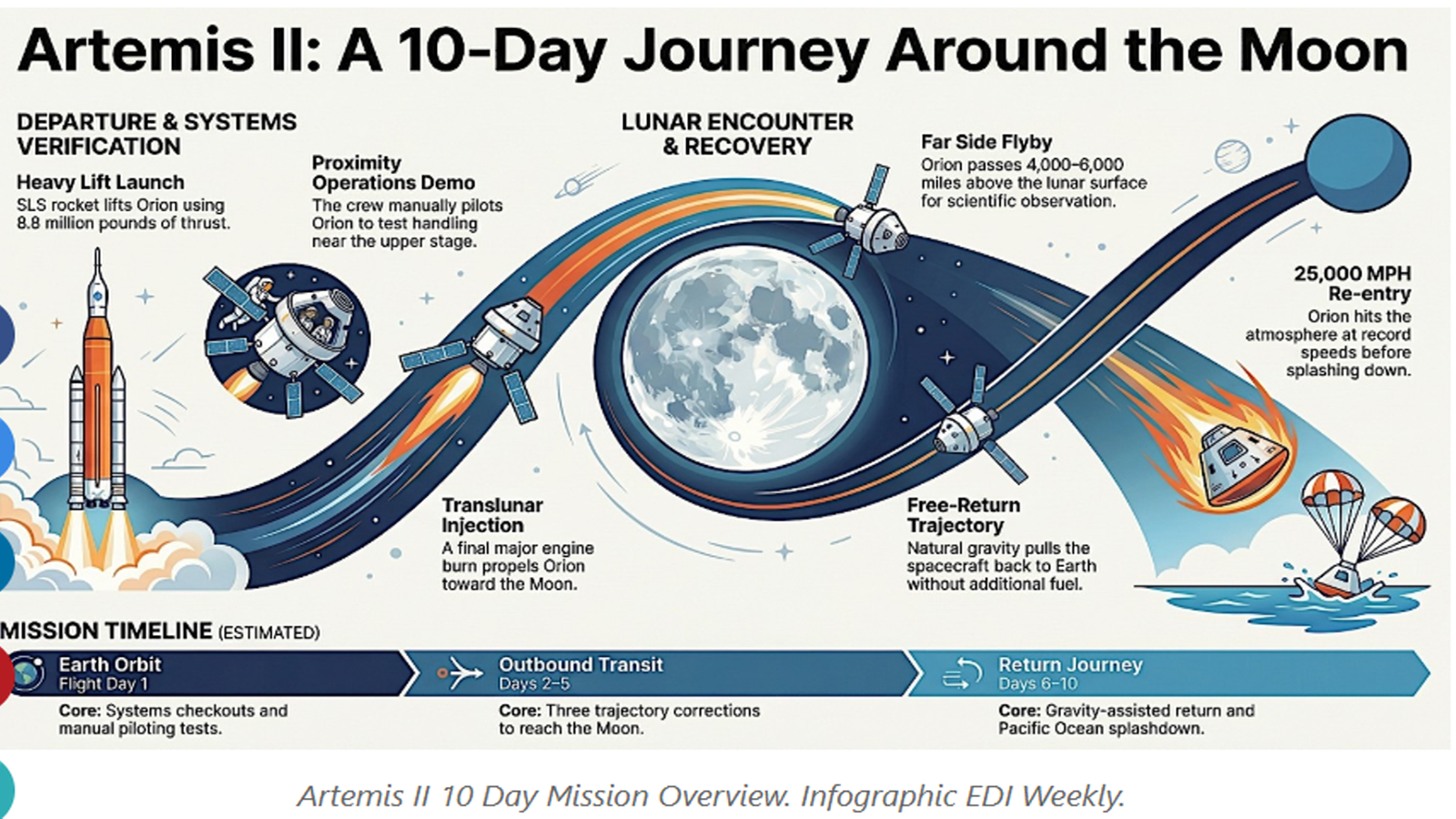
    NASA’s Artemis II recap reads, at first glance, like a historic space milestone: four astronauts, one Orion spacecraft, a nearly 10-day journey around the Moon, and a Pacific Ocean splashdown. But beneath the public image of a lunar flyby sits a deeper industrial story. Artemis II was not only a test of courage or technology. It was a test of whether a vast chain of engineering, manufacturing, logistics, safety systems, ground operations, and mission control could perform as one synchronized machine.

    NASA says Artemis II launched on April 1, 2026, on a nearly 10-day voyage around the Moon, carrying NASA astronauts Reid Wiseman, Victor Glover, Christina Koch, and Canadian Space Agency astronaut Jeremy Hansen aboard Orion. The crew splashed down on April 10 in the Pacific Ocean off San Diego, marking the first crewed flight of NASA’s Orion spacecraft.

    That single paragraph contains the visible result. What it does not fully show is the industrial architecture behind the mission. A crewed lunar flight requires far more than a rocket on a launch pad. It requires life-support confidence, reentry protection, propulsion performance, communications reliability, abort systems, recovery planning, and thousands of small manufacturing and verification decisions made long before launch day.

    Shop strapless bras in a variety of sizes like 32AA, 34DD, and more. Find stick on bras, bras with removable straps \& more to go with open back dresses.

    This is why Artemis II belongs in the Chain bucket. The mission was a demonstration of aerospace depth. Every successful milestone points backward to suppliers, test facilities, program managers, integration teams, technicians, software engineers, safety reviewers, and recovery crews. In strategic-industry terms, the question is not simply whether a spacecraft can fly. The question is whether a national industrial system can repeatedly build, test, launch, recover, analyze, and improve such a spacecraft.

    NASA’s early post-mission assessment also points in that direction. The agency said engineers began analyzing Artemis II data after splashdown and noted that the Space Launch System rocket met its mission objectives, with early assessment showing that it placed Orion accurately where it needed to be in space.

    That matters because modern aerospace power is not measured only by peak performance. It is measured by repeatability. A nation can stage a dramatic launch once. The harder test is whether it can turn that achievement into a reliable cycle: mission, data, correction, production, next mission. Artemis II therefore becomes less a single event and more a pressure test of long-cycle aerospace manufacturing.

    The Orion spacecraft is especially important in this regard. NASA’s Artemis II mission profile was designed to demonstrate deep-space capabilities for both the Space Launch System and Orion, including proving Orion’s life-support systems and practicing operations needed for Artemis III and later missions.

    That is the quiet strategic significance of the mission. Artemis II was not an endpoint. It was a bridge. It connected the uncrewed Artemis I test campaign with future crewed lunar operations. It also gave NASA and its partners a data-rich basis for judging what worked, what must be refined, and which parts of the production chain can support a more ambitious lunar architecture.

    For industry watchers, the lesson is clear. The most important space programs are not just about rockets. They are about the ecosystem that makes rockets usable. Launch vehicles, crew capsules, avionics, thermal systems, power systems, communications, recovery assets, and ground infrastructure all have to mature together. Any weak link becomes a mission risk.

    That is why Artemis II should be read as a supply-chain signal. It shows how strategic aerospace capability depends on depth, patience, and integration discipline. The public remembers the crew and the Moon. Industry should study the chain that made both possible.

    In the next phase of space competition, the winner will not simply be the country that launches the most spectacular mission. It will be the country — and the industrial network — that can keep launching, keep learning, and keep turning mission experience into production confidence.

    Original source

    Why It Matters

    Artemis II highlights the industrial depth required for crew systems, mission integration, and long-cycle aerospace production. The mission is not only a space exploration milestone. It is a case study in how complex strategic industries convert engineering ambition into operational capability.

    References

    NASA, “Artemis II Mission Milestones: An Image and Video Recap.”
    NASA, “NASA on Track for Future Missions with Initial Artemis II Assessments.”
    NASA, “Artemis II Press Kit.”

    Socko/Ghost

  • NASA’s JPL Contract Competition Signals a Shift in Space Research Management

    NASA’s JPL Contract Competition Signals a Shift in Space Research Management

    NASA’s decision to compete the next contract for managing and operating the Jet Propulsion Laboratory is more than an administrative procurement notice. It is a signal that even America’s most iconic space research institutions are being pulled into a new era of competition, efficiency pressure, and space-economy governance.

    NASA announced on May 22, 2026 that it plans to compete the next management and operations contract for the Jet Propulsion Laboratory in Southern California. JPL is a federally funded research and development center, or FFRDC, and NASA said the competition is intended to ensure accountability and strong value for U.S. taxpayers.

    The institutional history makes the decision significant. Caltech has managed JPL since the laboratory’s inception in the 1930s, and NASA states that previous management and operations contracts have been awarded sole source to Caltech since the facility was transferred from the U.S. Army to NASA in 1958.

    For SockoPower, the signal is not that JPL’s scientific role is suddenly in doubt. The signal is that NASA is testing whether the management model for a major space research center should remain insulated from competition or be opened to alternative operating approaches.

    Shop strapless bras in a variety of sizes like 32AA, 34DD, and more. Find stick on bras, bras with removable straps \& more to go with open back dresses.

    NASA’s own language points to the larger shift. The agency said the rapid growth of the U.S. space economy indicates there may now be a viable competitive market for programmatic and institutional elements of FFRDC operations. That is the core industrial signal: the private and institutional space ecosystem may now be deep enough to challenge long-standing management assumptions.

    This matters because JPL is not a small support office. It is one of the central institutions in U.S. robotic space exploration, mission engineering, planetary science, deep-space systems, and advanced technical execution. A competition for its management structure is therefore also a test of how NASA thinks about mission performance, cost control, innovation, and operational governance.

    The current Caltech contract began on October 1, 2018 and runs through September 30, 2028. NASA says the contract has a potential maximum value of $30 billion if all options are exercised. Starting the procurement process now gives the agency time to run a full competition and award cycle while maintaining continuity for ongoing missions and laboratory operations.

    That continuity point is important. NASA is not describing this as a shutdown, a mission cancellation, or a sudden break with JPL’s scientific legacy. It is presenting the move as a procurement and governance decision aimed at evaluating alternative management approaches, mission performance, innovation, cost efficiency, and operational efficiency.

    The broader space-economy implication is clear. NASA’s legacy research centers and FFRDCs are now operating in an environment where commercial space companies, universities, systems integrators, and technical service providers have expanded significantly. That does not mean any alternative manager can easily replace Caltech’s institutional knowledge. It does mean NASA wants to test the market rather than assume the old structure remains the only viable model.

    For Strategic Reports, this is a governance story with industrial consequences. Mission outcomes depend not only on spacecraft design, launch windows, scientific instruments, and engineering talent. They also depend on contract structures, management incentives, procurement rules, cost discipline, institutional culture, and the ability to execute complex programs without losing technical depth.

    The decision also fits a larger trend in space policy. Public space agencies are increasingly under pressure to move faster, operate more efficiently, and draw more value from a commercial ecosystem that did not exist at today’s scale when older management models were created. NASA’s JPL decision puts that pressure directly on one of the agency’s most prestigious institutions.

    The narrow takeaway is this: NASA is not merely recompeting a contract. It is testing whether the management of elite space research infrastructure should evolve with the commercial space economy. If the competition results in a new management model, it could become a precedent for how government science and engineering centers are governed in a more competitive space-industrial environment.

    Original source

    Why It Matters

    This item matters because JPL’s management contract sits at the intersection of space science, procurement, institutional governance, and the commercial space economy. NASA’s decision to compete the next JPL contract suggests that even long-standing research-center management models may be reassessed for mission performance, innovation, cost efficiency, and operational accountability.

    SockoPower Takeaway

    The JPL contract competition is not just a Caltech story. It is a space-industrial governance signal. As the U.S. space economy expands, NASA appears more willing to test whether legacy operating models still deliver the best mix of technical depth, speed, accountability, and cost performance.

    What to Watch Next

    Watch whether Caltech retains the JPL management contract or whether a new institutional or industry-led team emerges.

    Watch how NASA defines the competition criteria for mission performance, innovation, cost efficiency, and operational continuity.

    Watch whether private aerospace firms, universities, or consortia position themselves for parts of the FFRDC management opportunity.

    Watch how the competition affects JPL’s ongoing mission portfolio, workforce continuity, and long-term technical culture.

    Watch whether NASA applies similar competitive logic to other major research, engineering, or mission-support institutions.

    References

    NASA, “NASA to Compete Contract for Jet Propulsion Laboratory Management,” May 22, 2026.

    Socko/Ghost

  • China’s WTO Panel Request Against India Puts Solar and IT Supply Chains Under Trade Pressure

    China’s WTO Panel Request Against India Puts Solar and IT Supply Chains Under Trade Pressure

    China’s request for a WTO dispute panel against India is not a routine trade quarrel. It places solar cells, solar modules, and information technology goods at the center of a broader fight over industrial policy, market access, and strategic supply chains.

    At a meeting of the WTO Dispute Settlement Body on May 22, 2026, members considered China’s request for the establishment of a dispute panel to review Indian measures affecting imports of solar cells, solar modules, and information technology goods. The WTO said the dispute concerns measures that China argues affect imports in these sectors, while India maintained that its measures are consistent with WTO rules.

    For SockoPower’s Signal category, the core issue is the product mix. Solar cells and solar modules sit inside the renewable energy supply chain. Information technology goods sit inside the ICT and digital infrastructure chain. Together, they touch two strategic systems: energy transition and technology hardware.

    The case began in December 2025, when China requested WTO consultations with India over certain Indian measures on solar cells, solar modules, and information technology goods. Consultations are the first stage of the WTO dispute process, and a panel request usually follows when the parties do not reach a mutually agreed solution.

    India reportedly blocked China’s first request for a WTO dispute panel at the May 22 DSB meeting. That is procedurally important but not unusual: under WTO practice, a respondent can block the first panel request, but a renewed request at a later DSB meeting is typically established unless there is consensus against it. Indian press reports said the dispute concerns China’s allegations about India’s tariffs or import duties on certain technology products and measures favoring domestic products over imports.

    Shop strapless bras in a variety of sizes like 32AA, 34DD, and more. Find stick on bras, bras with removable straps \& more to go with open back dresses.

    The strategic signal is sharper than the legal procedure. China is challenging Indian measures in sectors where both countries have strong industrial ambitions. India wants to build domestic capacity in solar manufacturing and technology hardware. China remains a dominant force in global solar manufacturing and a major exporter of technology goods. A WTO dispute over these sectors therefore becomes more than a tariff argument; it becomes a test of how far industrial policy can go before it collides with trade rules.

    India’s response also matters. According to reports on the DSB meeting, India argued that its measures are consistent with WTO rules and pointed to the need for responsible and diversified supply chains. India also referenced China’s large share of the global solar module value chain. That framing turns the dispute into a supply-chain security argument, not merely a market-access complaint.

    For clean energy, the case is significant because solar supply chains are already geopolitically sensitive. Solar cells and modules are not just climate-policy inputs. They are industrial products tied to manufacturing capacity, energy security, local content policies, trade remedies, and national subsidy strategies. When these products become the subject of WTO dispute escalation, it shows that energy transition hardware is now part of strategic trade conflict.

    For ICT goods, the dispute points to a parallel issue. Technology hardware markets are shaped by tariff schedules, domestic manufacturing incentives, and commitments under WTO rules. If India’s measures are found to conflict with its obligations, the case could affect how India structures future support for technology manufacturing. If India successfully defends its measures, it may reinforce room for industrial-policy design under trade constraints.

    The narrow takeaway is this: China’s WTO panel request against India is a strategic-technology signal. It does not directly concern military procurement, but it does concern the industrial base behind solar energy, ICT hardware, and digital infrastructure. For SockoPower, that is enough to justify tracking the case closely.

    Original source

    Why It Matters

    This item may indicate a policy, technology, and supply-chain direction worth watching. China’s WTO panel request targets Indian measures affecting solar cells, solar modules, and information technology goods — sectors tied to renewable energy infrastructure, ICT hardware, domestic manufacturing, and strategic market access.

    SockoPower Takeaway

    The China–India WTO dispute is not just about tariffs. It is about whether industrial policy for solar and IT goods can survive inside trade-law constraints. For strategic industry watchers, the case shows how energy transition hardware and digital infrastructure are becoming contested terrain in global trade rules.

    What to Watch Next

    Watch whether China submits a second request for a WTO panel and whether the panel is formally established at a future DSB meeting.

    Watch how India defends its solar and IT measures under WTO rules.

    Watch whether the dispute affects India’s domestic solar manufacturing and technology-hardware incentive design.

    Watch how the case interacts with broader efforts to diversify solar supply chains away from China.

    Watch whether other economies use similar WTO challenges against local-content or incentive-based industrial policies in strategic sectors.

    References

    WTO, “Members consider Chinese request for dispute panel on solar, IT goods measures in India,” May 22, 2026.
    WTO, “China initiates dispute regarding Indian measures on solar cells and information technology goods,” December 23, 2025.
    The Economic Times, “India blocks China’s request for dispute panel on solar sector support measures at WTO,” May 22, 2026.

    Socko/Ghost

  • Basel Committee Moves Digital Risk, Cryptoassets, and Liquidity Back Into the Banking Spotlight

    Basel Committee Moves Digital Risk, Cryptoassets, and Liquidity Back Into the Banking Spotlight

    The Basel Committee’s May 2026 meeting shows that bank regulation is moving deeper into the digital operating layer of finance. The Committee agreed to publish a report on information and communication technology risk management, progressed its targeted review of the prudential standard for banks’ cryptoasset exposures, and considered whether its liquidity risk principles need targeted updates. For SockoPower’s Capital category, the signal is clear: operational resilience, cyber risk, cryptoasset exposures, and liquidity governance are becoming part of the same supervisory map.

    The Basel Committee met in Basel on May 19–20, 2026 to discuss a range of initiatives. Its financial stability discussion noted that the global banking system remains resilient, supported by robust capital and liquidity positions, but also warned that heightened tensions, including conflict in the Middle East, could create second- and third-order effects through inflationary pressure, supply chain disruptions, and sector-specific impacts such as energy and agriculture.

    That matters because bank resilience is no longer judged only by capital ratios. Banks now depend on digital infrastructure, cyber defenses, third-party systems, cloud services, data flows, payment rails, market connections, and operational continuity. A bank can meet capital requirements and still face serious risk if its ICT systems fail, if cyber incidents scale quickly, or if digital dependencies are not properly governed.

    The Committee’s digitalisation section is the core of this item. BIS says the Basel Committee approved a report describing observed ICT risk management practices across jurisdictions for addressing non-malicious ICT incidents. The report is expected to be published next month. BIS also states that ICT plays a vital role in operational risk management and broader operational resilience.

    Shop strapless bras in a variety of sizes like 32AA, 34DD, and more. Find stick on bras, bras with removable straps \& more to go with open back dresses.

    This is a strong Capital signal. ICT risk is not only an IT department issue. It is a financial stability issue. If bank systems, market interfaces, payment functions, or data infrastructure are disrupted, the effect can move from operational inconvenience to liquidity stress, customer confidence risk, settlement delay, and supervisory concern.

    The AI angle makes the signal sharper. BIS notes that the Committee discussed recent developments in artificial intelligence models and their implications for banks’ cybersecurity. Frontier AI models may help banks and supervisors identify vulnerabilities and strengthen defenses, but their malicious use may materially change the speed and scale of cyber incidents.

    That sentence matters for strategic finance. AI is now entering both sides of the cyber-risk equation. Banks can use AI to strengthen security, but attackers can also use AI to accelerate reconnaissance, phishing, malware adaptation, vulnerability discovery, and attack scaling. For capital markets, this means cyber risk is becoming faster, more automated, and harder to separate from operational resilience.

    The cryptoasset section is also important. BIS says the Committee has expedited a targeted review of elements of its prudential standard for banks’ cryptoasset exposures and that an update will be provided later this year. The signal is not that banks are being pushed aggressively into crypto. The signal is that cryptoasset exposures are being brought further into the prudential risk perimeter.

    For Capital, that matters because crypto markets increasingly intersect with banks through custody, settlement services, tokenized assets, stablecoins, client exposure, indirect instruments, and market infrastructure experiments. Even when banks’ direct exposures are limited, prudential standards shape whether regulated banks participate, avoid, or restrict activity in digital-asset markets.

    Liquidity risk is the third major watchpoint. The Committee agreed to consider whether targeted updates to its Principles for Sound Liquidity Risk Management and Supervision are needed. Those principles were published in September 2008, and BIS notes that regulatory, supervisory, and structural developments since then may justify a review of whether the principles remain fit for purpose.

    That is not a small signal. Liquidity risk has changed since 2008. Digital banking, faster information flows, social-media-driven depositor behavior, non-bank financial intermediation, private credit links, central bank balance sheet shifts, and real-time market stress can all affect how quickly liquidity pressure moves through the system. If Basel updates liquidity risk principles, it could influence supervisory expectations for banks worldwide.

    The Committee also discussed non-bank financial intermediation, including private credit. BIS states that banks’ direct exposures to private credit appear contained in aggregate, but indirect exposures and interconnections remain a watchpoint. That fits the broader message: risk is increasingly found in connections, not only in balance-sheet line items.

    The narrow takeaway is this: Basel supervision is shifting toward connected risk. ICT incidents, AI-enabled cyber threats, cryptoasset exposures, liquidity principles, private credit links, and extreme weather impacts are separate topics on paper, but they all point to the same underlying issue. Modern banking risk is increasingly operational, digital, cross-sector, and fast-moving.

    For SockoPower, this belongs in Capital because it affects the operating environment for banks, funding, pricing, supervision, digital finance, and market confidence. The headline is not a new capital rule. The headline is that the regulatory agenda is moving toward the infrastructure and risk channels that can transmit stress before traditional ratios show damage.

    Original source

    Why It Matters

    This item may affect capital allocation because digital resilience, cryptoasset prudential rules, and liquidity risk principles shape how banks manage risk, allocate balance-sheet capacity, and participate in emerging financial infrastructure. The Basel Committee’s agenda shows that operational resilience and digital risk are becoming core supervisory issues, not side topics.

    SockoPower Takeaway

    The Basel Committee is not only watching capital ratios. It is watching the systems that allow banks to function. ICT risk, AI-enabled cyber threats, cryptoasset exposure, liquidity governance, and private-credit interconnections all point to a banking system where resilience depends on digital infrastructure as much as balance-sheet strength.

    What to Watch Next

    Watch the Basel Committee’s forthcoming ICT risk management report and whether it creates a stronger benchmark for bank operational resilience practices.

    Watch the targeted review of banks’ cryptoasset exposure standard and whether it changes the cost or feasibility of regulated bank participation in digital-asset markets.

    Watch whether the Committee moves from considering liquidity principle updates to formal consultation or revised guidance.

    Watch how AI-related cybersecurity risks appear in future supervisory statements.

    Watch whether private credit interconnections become a larger focus of bank supervision.

    References

    BIS, “Basel Committee agrees to publish report on information and communication technology risk management, progresses cryptoasset targeted review, considers targeted updates on liquidity risk principles,” May 20, 2026.

    Socko/Ghost

  • NASA’s Greenbelt Image Shows How Urban Growth and Green Space Share the Same Chain

    NASA’s Greenbelt Image Shows How Urban Growth and Green Space Share the Same Chain

    NASA’s “Belts of Green in the Washington Suburbs,” published as an Earth Observatory Image of the Day on April 22, 2026, is a small but useful land-use signal. The image shows the northeast side of the Capital Beltway in Maryland, where green spaces are woven through suburban development near Greenbelt. For SockoPower’s Chain category, the point is not spaceflight hardware. It is the way Earth observation helps identify how cities, parks, transport corridors, research campuses, and agricultural zones coexist inside a developed metropolitan region.

    The photograph was taken from the International Space Station on July 30, 2023, using a 35mm camera, and NASA classifies the image under land use and urban development. That classification matters because the image is not merely scenic. It is a view of the built environment as an operating system: highways, neighborhoods, forested land, research facilities, campuses, and green corridors placed side by side.

    The central location is Greenbelt, Maryland, on the northeast side of the Capital Beltway. NASA notes that the Beltway encircles Washington, D.C., and that numerous suburbs across Virginia and Maryland are accessible from it. The image captures the area where the Beltway passes through historic Greenbelt, a city whose original planning already connected housing, walking paths, shopping, and accessible green space.

    One of the most visible green areas is Greenbelt Park. NASA describes the park as nearly 5 square kilometers, or about 2 square miles, with forested hiking trails, picnic areas, and a campground. The land was once intended as a future extension of the city of Greenbelt, but it was acquired by the National Park Service in 1950.

    The image also contains a strategic institutional layer. East of the Beltway is NASA’s Goddard Space Flight Center, which NASA describes as its first spaceflight complex, established in Greenbelt on May 1, 1959. Around it are patches of forested land, while larger green areas to the north include forest and agricultural fields in Beltsville, including University of Maryland and USDA agricultural research sites.

    Shop strapless bras in a variety of sizes like 32AA, 34DD, and more. Find stick on bras, bras with removable straps \& more to go with open back dresses.

    That is the narrow Chain relevance. Green space here is not just decoration around suburbia. It is part of a regional pattern that includes transport infrastructure, federal research facilities, agricultural research, university activity, residential planning, and environmental buffer zones. From orbit, these elements appear as one connected landscape rather than separate policy categories.

    The takeaway should be modest. This NASA image does not announce a new infrastructure program or a new industrial policy. It shows how astronaut photography can make the structure of a metropolitan chain visible: roads connect suburbs, research campuses anchor technical activity, green spaces buffer development, and agricultural sites preserve land-based research capacity near the national capital region.

    For SockoPower, the value of this item is that it keeps Chain from becoming only a story about factories, ships, satellites, or supply routes. Physical land use also belongs to the chain. Parks, research campuses, green corridors, and agricultural test sites shape how metropolitan systems absorb growth, manage environmental pressure, and support long-term institutional capacity.

    Original source

    Why It Matters

    This item matters because it shows how Earth observation can reveal the land-use structure behind urban resilience. NASA’s image of Greenbelt connects suburban development, transport infrastructure, federal research facilities, parks, and agricultural research sites into a single visible pattern. For Chain, the signal is that green infrastructure and research landscapes remain part of the operating base of a metropolitan system.

    SockoPower Takeaway

    The Greenbelt image is not a space technology story. It is a land-use signal. From the ISS, NASA shows how green space, research infrastructure, and suburban development share the same geography around the Capital Beltway. The strategic value lies in seeing urban growth and environmental buffers as parts of one regional chain.

    What to Watch Next

    Watch how NASA Earth Observatory images continue to document urban development, land-use pressure, and green infrastructure around major metropolitan regions.

    Watch whether public agencies use satellite and astronaut photography more actively to communicate urban resilience, research geography, and environmental planning.

    Watch how research campuses, agricultural fields, and green corridors remain embedded inside developed regions rather than pushed entirely outside them.

    References

    NASA Earth Observatory, “Belts of Green in the Washington Suburbs,” April 22, 2026.

    Socko/Ghost

  • RTX and Rheinmetall: How Capital Markets Are Forcing Defense Giants to Redesign Their Supply Chains

    RTX and Rheinmetall: How Capital Markets Are Forcing Defense Giants to Redesign Their Supply Chains

    The restructuring of global defense supply chains is no longer driven solely by military demand or geopolitical tension.
    It is increasingly dictated by capital markets.

    Two companies illustrate this shift with particular clarity: RTX and Rheinmetall.
    Both face surging demand from rearmament cycles, yet both are reshaping their supply chains not for production speed—but for investor compatibility.


    Capital Pressure as a Strategic Constraint

    For much of the post–Cold War era, defense supply chains optimized for cost efficiency and global sourcing. That model is breaking down.

    Institutional investors now evaluate defense firms through overlapping filters:

    • ESG exposure
    • Geopolitical alignment
    • Sanctions and export-control resilience
    • Supply-chain transparency
    Shop strapless bras in a variety of sizes like 32AA, 34DD, and more. Find stick on bras, bras with removable straps & more to go with open back dresses.

    RTX and Rheinmetall are responding by rewriting how defense manufacturing is organized, not merely where it is located.


    RTX: Simplifying the Supply Chain to Preserve Capital Access

    RTX’s challenge is not securing contracts—the backlog is strong across missiles, sensors, and aerospace systems.
    The challenge is maintaining investor confidence amid complexity.

    RTX has moved to:

    • Reduce deep-tier supplier opacity in electronics and propulsion
    • Prioritize sourcing from politically aligned jurisdictions
    • Consolidate critical suppliers to improve auditability and disclosure

    These decisions are not primarily about cost. They are about lowering perceived ESG and geopolitical risk so that large institutional capital—pension funds, sovereign investors, and long-duration asset managers—remains accessible.

    In effect, RTX is trading some supply-chain flexibility for capital predictability.


    Rheinmetall: Turning Geopolitics into a Capital Asset

    Rheinmetall’s transformation is more overt.

    Once viewed largely as a German land-systems producer, Rheinmetall has repositioned itself as:

    • A core European defense supplier
    • A beneficiary of NATO-aligned reindustrialization
    • A politically “safe” alternative to globally dispersed competitors

    The company is expanding production capacity within Europe while tightening control over suppliers of ammunition components, armored systems, and critical subassemblies.

    This strategy signals to capital markets that Rheinmetall’s growth is structurally protected by alliance politics, not dependent on volatile export markets.

    For investors, geopolitical alignment becomes not a risk—but a valuation support mechanism.


    What These Firms Are Really Optimizing For

    RTX and Rheinmetall are not simply responding to war demand.
    They are responding to a new reality:

    As a result:

    • Lowest-cost suppliers are losing relevance
    • Politically aligned suppliers gain pricing power
    • Tier-2 and Tier-3 firms face consolidation or exclusion
    • Vertical integration becomes a financial, not ideological, choice

    Supply chains are being rebuilt to survive capital scrutiny, not just battlefield attrition.


    Strategic Implication for the Defense Industry

    The lesson from RTX and Rheinmetall is clear:

    Those that fail this test may still win contracts—but lack the financial depth to execute them at scale.

    Socko/Ghost