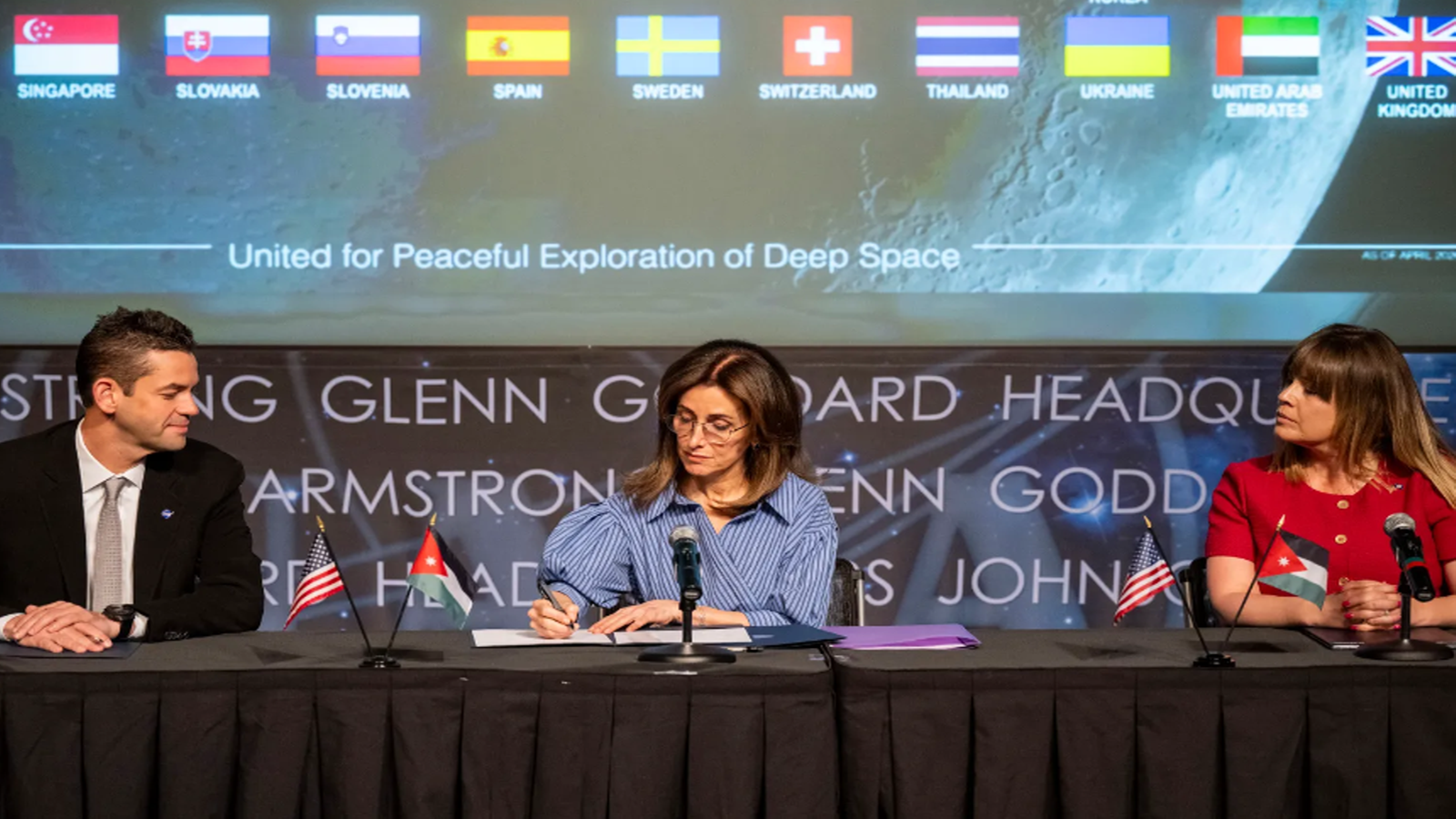
Jordan’s signing of the Artemis Accords may look like a diplomatic ceremony at NASA Headquarters. In reality, it is another small but telling piece of a much larger shift: the new space race is no longer defined only by rockets, capsules, and launch pads. It is increasingly defined by alliances, rules, standards, engineering talent, and the ability of nations to plug into a long-term lunar-industrial network.
NASA first announced that the Hashemite Kingdom of Jordan would sign the Artemis Accords at a ceremony at NASA Headquarters in Washington on April 23, 2026. The ceremony was hosted by NASA Administrator Jared Isaacman, with Jordan’s Ambassador to the United States Dina Kawar and U.S. State Department official Ruth Perry participating. NASA later confirmed that Jordan had signed the accords and became the 63rd nation to join the framework.
That number matters. The Artemis Accords began in 2020, when the United States, led by NASA and the State Department, joined with seven other founding nations to establish a set of principles for civil space exploration amid growing government and private-sector interest in lunar activity. What started as a space-policy framework is now becoming a diplomatic map of the coming Moon economy.
For SockoPower’s Chain bucket, the significance is not merely that another country signed a document. The deeper point is that space exploration now depends on a chain of trust. Lunar missions require shared expectations about transparency, interoperability, emergency assistance, scientific data, registration of space objects, and sustainable operations. NASA’s own Artemis Accords page emphasizes open scientific data sharing, while the U.S. State Department lists principles including peaceful purposes, transparency, interoperability, emergency assistance, and registration of space objects.
This is where the industrial dimension appears. A lunar program is not built by one agency alone. It requires launch systems, crew modules, communications networks, robotics, navigation, software, materials, ground infrastructure, logistics, recovery systems, and eventually lunar surface operations. But those technical systems cannot scale internationally unless nations also agree on basic rules of cooperation.
Jordan’s entry is especially interesting because it connects space diplomacy with national technology ambition. NASA’s post-signing release quoted Ambassador Dina Kawar as saying that Jordan has “more engineers per capita than almost any country in the world,” and that the country aims to develop as a technology hub across AI, digital infrastructure, advanced manufacturing, and now space. That statement points beyond symbolism. It frames space not as a prestige project, but as part of a broader industrial modernization strategy.

In practical terms, the Artemis Accords are becoming a gateway into future space cooperation. Not every signatory will build rockets. Not every country will send astronauts to the Moon. But many can contribute through software, sensors, data systems, materials, communications, robotics, manufacturing, research, education, or specialized technical services. The lunar economy will not be one giant factory. It will be a distributed chain.
That is why a signing ceremony in Washington belongs in the Chain category. The story is not only about Jordan. It is about how space power is being reorganized. The United States is building a coalition around Artemis. Partner countries are positioning themselves inside that architecture. Private companies are watching for standards and opportunities. Smaller and mid-sized nations are looking for entry points into a market that may define the next generation of advanced technology.
The Moon, in this sense, is not just a destination. It is a test of whether international cooperation can be converted into durable industrial capability. The countries that sign today may become the suppliers, researchers, operators, and technical partners of tomorrow.
The old space race was a contest of flags. The new one is becoming a contest of networks. Jordan’s signature is one more link in that chain.
Why It Matters
Jordan’s Artemis Accords signing highlights how future lunar exploration will depend not only on spacecraft and launch systems, but also on international rules, technical compatibility, engineering talent, and long-cycle industrial cooperation. The Moon economy is becoming a partnership chain.
References
NASA, “NASA Invites Media to Jordan Artemis Accords Signing Ceremony.”
NASA, “NASA Welcomes Jordan as 63rd Artemis Accords Signatory.”
NASA, “Artemis Accords.”
U.S. Department of State, “Artemis Accords.”
Socko/Ghost
Leave a Reply