Tag: aerospace supply chain

  • Jordan Joins the Artemis Accords: The Moon Race Is Becoming a Partnership Chain

    Jordan Joins the Artemis Accords: The Moon Race Is Becoming a Partnership Chain

    Jordan’s signing of the Artemis Accords may look like a diplomatic ceremony at NASA Headquarters. In reality, it is another small but telling piece of a much larger shift: the new space race is no longer defined only by rockets, capsules, and launch pads. It is increasingly defined by alliances, rules, standards, engineering talent, and the ability of nations to plug into a long-term lunar-industrial network.

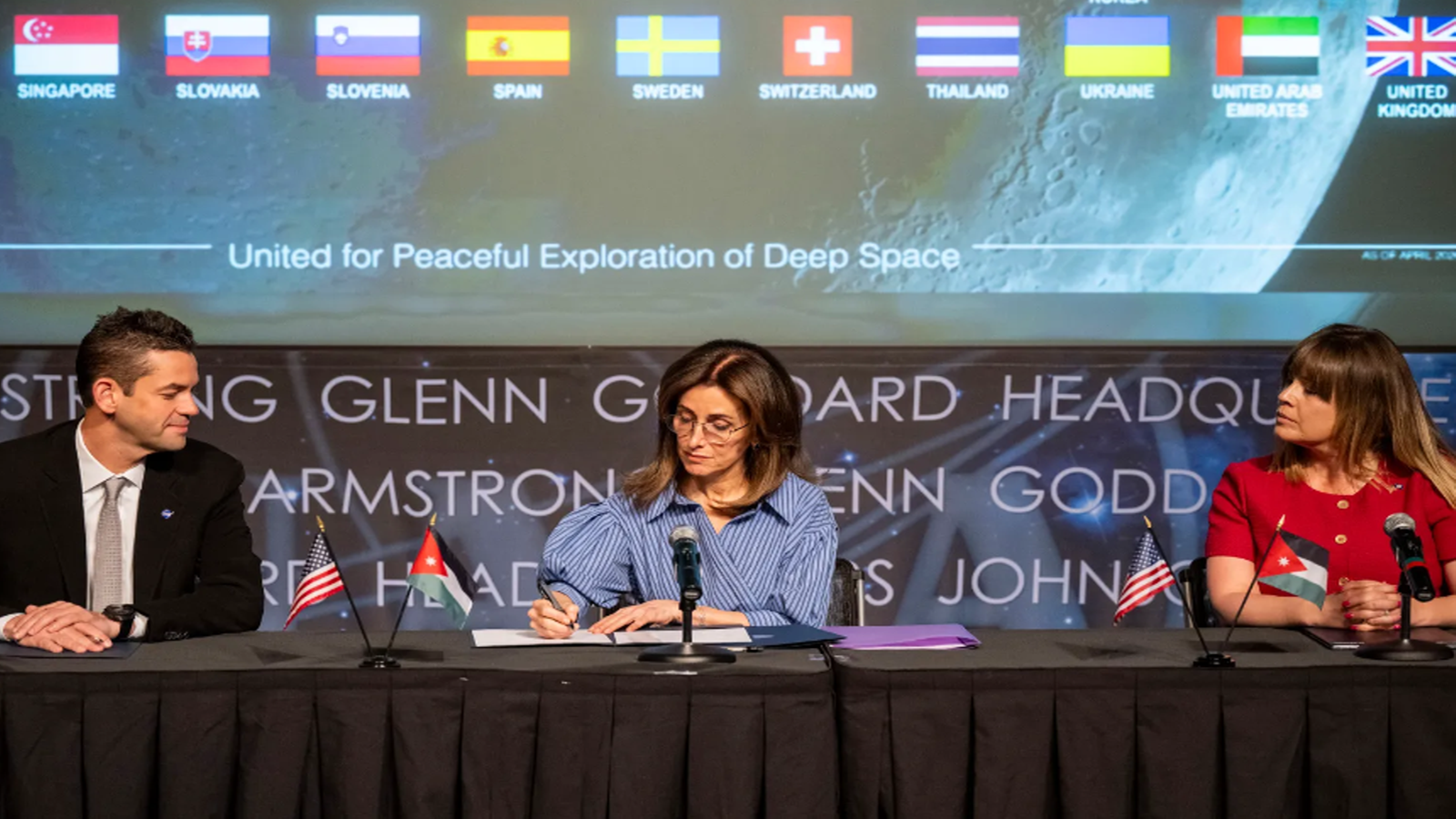
    NASA first announced that the Hashemite Kingdom of Jordan would sign the Artemis Accords at a ceremony at NASA Headquarters in Washington on April 23, 2026. The ceremony was hosted by NASA Administrator Jared Isaacman, with Jordan’s Ambassador to the United States Dina Kawar and U.S. State Department official Ruth Perry participating. NASA later confirmed that Jordan had signed the accords and became the 63rd nation to join the framework.

    That number matters. The Artemis Accords began in 2020, when the United States, led by NASA and the State Department, joined with seven other founding nations to establish a set of principles for civil space exploration amid growing government and private-sector interest in lunar activity. What started as a space-policy framework is now becoming a diplomatic map of the coming Moon economy.

    For SockoPower’s Chain bucket, the significance is not merely that another country signed a document. The deeper point is that space exploration now depends on a chain of trust. Lunar missions require shared expectations about transparency, interoperability, emergency assistance, scientific data, registration of space objects, and sustainable operations. NASA’s own Artemis Accords page emphasizes open scientific data sharing, while the U.S. State Department lists principles including peaceful purposes, transparency, interoperability, emergency assistance, and registration of space objects.

    This is where the industrial dimension appears. A lunar program is not built by one agency alone. It requires launch systems, crew modules, communications networks, robotics, navigation, software, materials, ground infrastructure, logistics, recovery systems, and eventually lunar surface operations. But those technical systems cannot scale internationally unless nations also agree on basic rules of cooperation.

    Jordan’s entry is especially interesting because it connects space diplomacy with national technology ambition. NASA’s post-signing release quoted Ambassador Dina Kawar as saying that Jordan has “more engineers per capita than almost any country in the world,” and that the country aims to develop as a technology hub across AI, digital infrastructure, advanced manufacturing, and now space. That statement points beyond symbolism. It frames space not as a prestige project, but as part of a broader industrial modernization strategy.

    Shop strapless bras in a variety of sizes like 32AA, 34DD, and more. Find stick on bras, bras with removable straps \& more to go with open back dresses.

    In practical terms, the Artemis Accords are becoming a gateway into future space cooperation. Not every signatory will build rockets. Not every country will send astronauts to the Moon. But many can contribute through software, sensors, data systems, materials, communications, robotics, manufacturing, research, education, or specialized technical services. The lunar economy will not be one giant factory. It will be a distributed chain.

    That is why a signing ceremony in Washington belongs in the Chain category. The story is not only about Jordan. It is about how space power is being reorganized. The United States is building a coalition around Artemis. Partner countries are positioning themselves inside that architecture. Private companies are watching for standards and opportunities. Smaller and mid-sized nations are looking for entry points into a market that may define the next generation of advanced technology.

    The Moon, in this sense, is not just a destination. It is a test of whether international cooperation can be converted into durable industrial capability. The countries that sign today may become the suppliers, researchers, operators, and technical partners of tomorrow.

    The old space race was a contest of flags. The new one is becoming a contest of networks. Jordan’s signature is one more link in that chain.

    Original source

    Why It Matters

    Jordan’s Artemis Accords signing highlights how future lunar exploration will depend not only on spacecraft and launch systems, but also on international rules, technical compatibility, engineering talent, and long-cycle industrial cooperation. The Moon economy is becoming a partnership chain.

    References

    NASA, “NASA Invites Media to Jordan Artemis Accords Signing Ceremony.”
    NASA, “NASA Welcomes Jordan as 63rd Artemis Accords Signatory.”
    NASA, “Artemis Accords.”
    U.S. Department of State, “Artemis Accords.”

    Socko/Ghost
  • The Moonshot Was the Headline. The Supply Chain Was the Mission.

    The Moonshot Was the Headline. The Supply Chain Was the Mission.

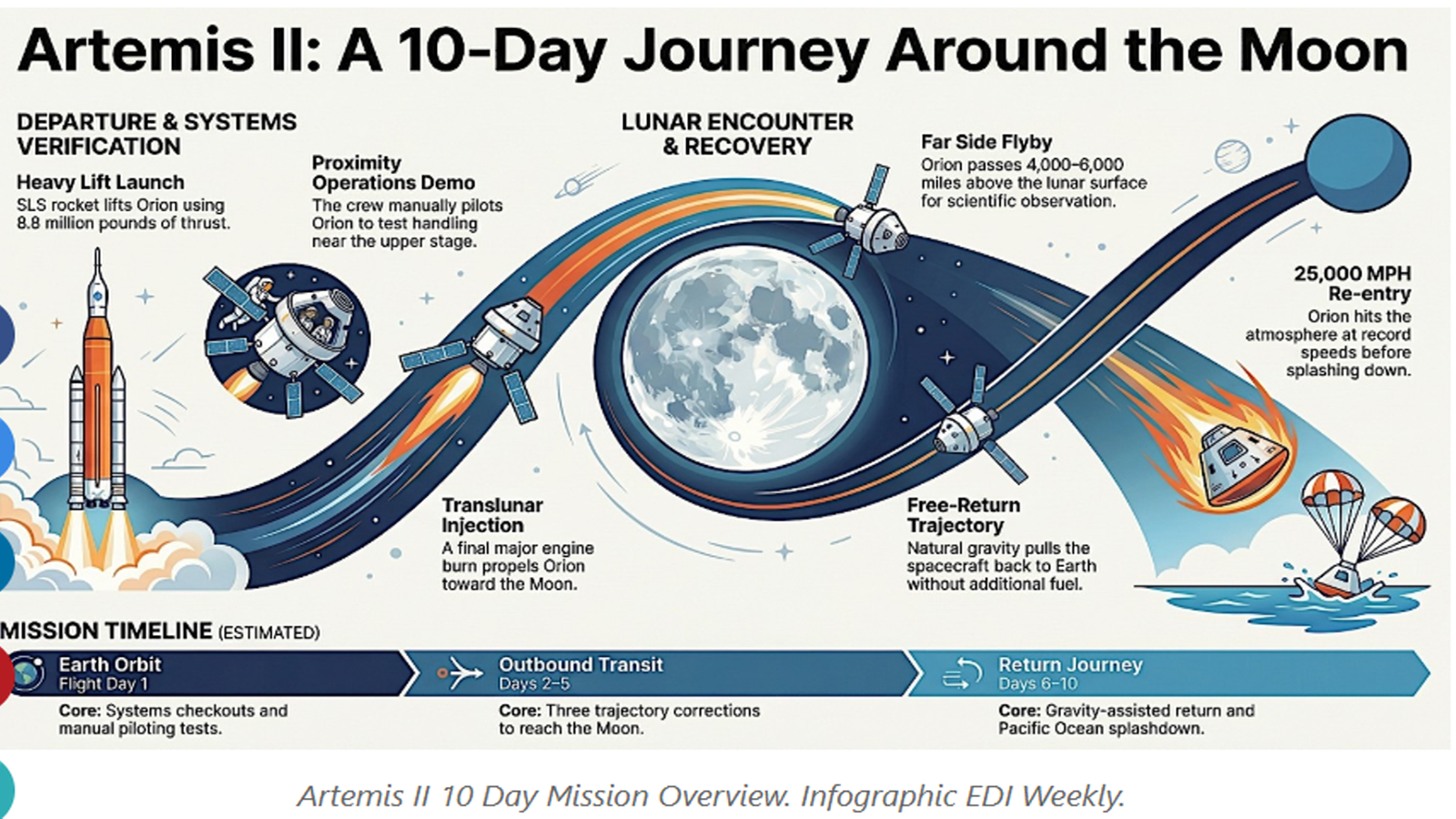
    NASA’s Artemis II recap reads, at first glance, like a historic space milestone: four astronauts, one Orion spacecraft, a nearly 10-day journey around the Moon, and a Pacific Ocean splashdown. But beneath the public image of a lunar flyby sits a deeper industrial story. Artemis II was not only a test of courage or technology. It was a test of whether a vast chain of engineering, manufacturing, logistics, safety systems, ground operations, and mission control could perform as one synchronized machine.

    NASA says Artemis II launched on April 1, 2026, on a nearly 10-day voyage around the Moon, carrying NASA astronauts Reid Wiseman, Victor Glover, Christina Koch, and Canadian Space Agency astronaut Jeremy Hansen aboard Orion. The crew splashed down on April 10 in the Pacific Ocean off San Diego, marking the first crewed flight of NASA’s Orion spacecraft.

    That single paragraph contains the visible result. What it does not fully show is the industrial architecture behind the mission. A crewed lunar flight requires far more than a rocket on a launch pad. It requires life-support confidence, reentry protection, propulsion performance, communications reliability, abort systems, recovery planning, and thousands of small manufacturing and verification decisions made long before launch day.

    Shop strapless bras in a variety of sizes like 32AA, 34DD, and more. Find stick on bras, bras with removable straps \& more to go with open back dresses.

    This is why Artemis II belongs in the Chain bucket. The mission was a demonstration of aerospace depth. Every successful milestone points backward to suppliers, test facilities, program managers, integration teams, technicians, software engineers, safety reviewers, and recovery crews. In strategic-industry terms, the question is not simply whether a spacecraft can fly. The question is whether a national industrial system can repeatedly build, test, launch, recover, analyze, and improve such a spacecraft.

    NASA’s early post-mission assessment also points in that direction. The agency said engineers began analyzing Artemis II data after splashdown and noted that the Space Launch System rocket met its mission objectives, with early assessment showing that it placed Orion accurately where it needed to be in space.

    That matters because modern aerospace power is not measured only by peak performance. It is measured by repeatability. A nation can stage a dramatic launch once. The harder test is whether it can turn that achievement into a reliable cycle: mission, data, correction, production, next mission. Artemis II therefore becomes less a single event and more a pressure test of long-cycle aerospace manufacturing.

    The Orion spacecraft is especially important in this regard. NASA’s Artemis II mission profile was designed to demonstrate deep-space capabilities for both the Space Launch System and Orion, including proving Orion’s life-support systems and practicing operations needed for Artemis III and later missions.

    That is the quiet strategic significance of the mission. Artemis II was not an endpoint. It was a bridge. It connected the uncrewed Artemis I test campaign with future crewed lunar operations. It also gave NASA and its partners a data-rich basis for judging what worked, what must be refined, and which parts of the production chain can support a more ambitious lunar architecture.

    For industry watchers, the lesson is clear. The most important space programs are not just about rockets. They are about the ecosystem that makes rockets usable. Launch vehicles, crew capsules, avionics, thermal systems, power systems, communications, recovery assets, and ground infrastructure all have to mature together. Any weak link becomes a mission risk.

    That is why Artemis II should be read as a supply-chain signal. It shows how strategic aerospace capability depends on depth, patience, and integration discipline. The public remembers the crew and the Moon. Industry should study the chain that made both possible.

    In the next phase of space competition, the winner will not simply be the country that launches the most spectacular mission. It will be the country — and the industrial network — that can keep launching, keep learning, and keep turning mission experience into production confidence.

    Original source

    Why It Matters

    Artemis II highlights the industrial depth required for crew systems, mission integration, and long-cycle aerospace production. The mission is not only a space exploration milestone. It is a case study in how complex strategic industries convert engineering ambition into operational capability.

    References

    NASA, “Artemis II Mission Milestones: An Image and Video Recap.”
    NASA, “NASA on Track for Future Missions with Initial Artemis II Assessments.”
    NASA, “Artemis II Press Kit.”

    Socko/Ghost

  • From Robotic Grippers to Space Welding: NASA’s SBIR/STTR Awards Map the Next Technology Chain

    From Robotic Grippers to Space Welding: NASA’s SBIR/STTR Awards Map the Next Technology Chain

    Source Record

    NASA’s April 21, 2026 SBIR/STTR announcement shows how space supply chains are built long before they appear as finished spacecraft, lunar systems, or mission hardware. By backing more than 30 small businesses working on in-space manufacturing, advanced batteries, propulsion, robotic gripping, in-space repair, storm tracking, and AI-enabled health monitoring, NASA is not simply funding isolated prototypes. It is cultivating the early technical nodes that can later feed into mission integration, commercial space services, and Earth-facing industrial applications.

    NASA’s April 21 announcement is not simply a small-business funding notice. It is a snapshot of how the space technology supply chain is formed before it becomes visible as a major mission, spacecraft, or industrial program.

    The agency announced the selection of more than 30 companies through its Small Business Innovation Research and Small Business Technology Transfer program, investing approximately $16.3 million in seed funding for technology solutions intended to support NASA missions and the broader space economy. NASA described the awards as part of its longstanding support for American industry.

    For SockoPower’s Chain category, the key point is the structure behind the awards. These are not finished systems. They are early-stage technologies that may later become parts of larger aerospace production chains: materials, sensors, robotics, software, propulsion tools, health-monitoring systems, and mission-support capabilities. The industrial value lies in how NASA uses small firms and research partnerships to mature technologies before they reach full-scale deployment.

    The awards come through two paths. NASA’s SBIR Ignite initiative focuses on commercialization and gives small businesses a path to market their technologies beyond potential NASA use. In this round, 15 firms from 10 states were selected for SBIR Ignite Phase I contracts of up to $150,000 each. NASA also announced STTR Phase II awards, involving small businesses partnered with research institutions, with 17 contracts valued at up to $850,000 each.

    That distinction matters. SBIR Ignite points toward commercial pull. STTR points toward research transfer between companies and institutions. Together, they show a supply-chain model in which NASA does not only buy mature systems from prime contractors. It helps cultivate technical nodes that may later feed into missions, defense-adjacent aerospace markets, commercial space services, and Earth-facing applications.

    Shop strapless bras in a variety of sizes like 32AA, 34DD, and more. Find stick on bras, bras with removable straps \& more to go with open back dresses.

    The selected technology areas are especially relevant to industrial depth. NASA identified award areas including in-space manufacturing, advanced battery technologies, lunar landings, and advanced propulsion for air and spacecraft. These are not isolated science topics. They are enabling layers for long-cycle aerospace production, mission integration, and future operations beyond low Earth orbit.

    The examples in NASA’s announcement make the chain visible. Nanoscale Labs received an SBIR Ignite Phase I award for bio-inspired adhesive materials that could help robots grip objects in space, where traditional vacuum grippers fail and debris or spacecraft components have irregular shapes. QuesTek Innovations received an SBIR Ignite Phase I award for a simulation toolkit designed to predict how welded materials behave in space, a challenge tied to future in-space repair and replacement work.

    NASA also highlighted ASTER Labs, which received an STTR Phase II award for the STORM Module, a software system intended to identify, track, and predict lightning-storm movement in real time from low Earth orbit. NASA noted that the technology may also be adapted to track wildfires or floods. That example connects space-based sensing directly to Earth applications, including severe-weather forecasting, disaster response, and risk monitoring.

    Another example is Tietronix Software, which is developing a portable monitoring platform with sensors, smartphone apps, AI, and extended reality tools to support astronaut health. NASA said the system could eventually support medical assistance for patients in remote environments on Earth. This is a classic dual-use pattern in space technology: a tool developed for extreme mission conditions can later migrate into terrestrial healthcare, remote operations, or field-support systems.

    The broader program shift is also important. NASA’s SBIR/STTR program is moving to a Broad Agency Announcement framework for 2026, replacing a more traditional annual solicitation cycle with phased appendix releases throughout the year. NASA says the shift is intended to make the program more flexible and responsive to changing mission priorities and commercial-market developments.

    That change is highly relevant to the supply chain. A more flexible solicitation structure allows NASA to seek technologies as needs emerge, rather than only through a fixed annual window. In practical terms, this can make small-business participation more continuous and better aligned with mission timing, technology gaps, and market movement.

    The narrow strategic meaning of this NASA item is therefore clear. This is not a story about one grant round. It is a story about how aerospace supply chains are seeded. Before a technology becomes a subsystem, before a subsystem becomes part of a mission, and before a mission becomes a market, early funding programs like SBIR and STTR help determine which technical pathways survive.

    For SockoPower, the signal is not the $16.3 million alone. The signal is the portfolio: robotic gripping, space welding, storm tracking, AI-enabled health monitoring, in-space manufacturing, advanced batteries, lunar landing systems, and propulsion. These are small technical pieces, but they point to the larger industrial architecture NASA is trying to build around future space and Earth applications.

    Original source

    Why It Matters

    This item highlights how NASA uses small-business funding to seed the industrial layers required for future aerospace systems. The awards point to technologies that support robotic operations, in-space repair, sensing, medical monitoring, advanced propulsion, lunar operations, and Earth-facing disaster intelligence. For the Chain category, the importance lies in how early-stage companies become technical nodes in the broader space supply chain.


    SockoPower Takeaway

    NASA’s SBIR/STTR awards show that space supply chains are not built only by large prime contractors. They begin earlier, through small firms, research partnerships, seed funding, prototypes, and mission-specific technical gaps. The companies selected in this round represent the lower layers of a future industrial stack: materials, software, sensors, robotics, health systems, and operational tools.


    What to Watch Next

    Watch which SBIR Ignite Phase I projects move toward commercialization beyond NASA missions.

    Watch which STTR Phase II technologies demonstrate enough maturity to enter larger mission or commercial pipelines.

    Watch how NASA’s new Broad Agency Announcement framework changes the rhythm of small-business participation in space technology development.

    Watch whether technologies in robotics, in-space repair, Earth sensing, and AI-enabled monitoring attract follow-on investment from defense, commercial space, healthcare, or disaster-response markets.

    References

    NASA, “NASA Invests in Small Businesses Innovating for Space and Earth,” April 21, 2026.
    NASA, “Small Business Innovation Research / Small Business Technology Transfer Program.”
    NASA, “NASA SBIR/STTR Program — Program Year 2026 Information Hub.”

    Socko/Ghost