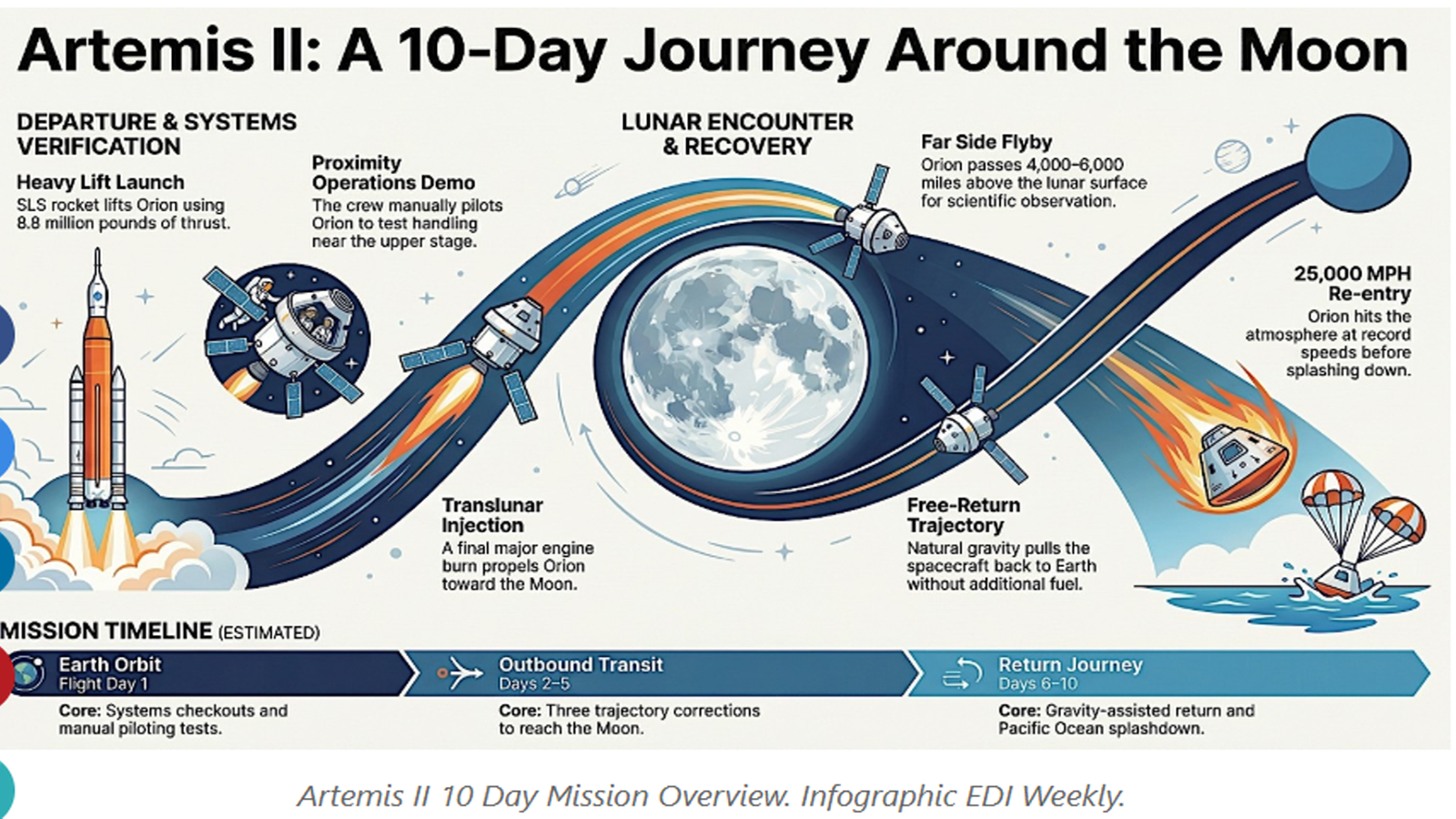
NASA’s Artemis II recap reads, at first glance, like a historic space milestone: four astronauts, one Orion spacecraft, a nearly 10-day journey around the Moon, and a Pacific Ocean splashdown. But beneath the public image of a lunar flyby sits a deeper industrial story. Artemis II was not only a test of courage or technology. It was a test of whether a vast chain of engineering, manufacturing, logistics, safety systems, ground operations, and mission control could perform as one synchronized machine.
NASA says Artemis II launched on April 1, 2026, on a nearly 10-day voyage around the Moon, carrying NASA astronauts Reid Wiseman, Victor Glover, Christina Koch, and Canadian Space Agency astronaut Jeremy Hansen aboard Orion. The crew splashed down on April 10 in the Pacific Ocean off San Diego, marking the first crewed flight of NASA’s Orion spacecraft.
That single paragraph contains the visible result. What it does not fully show is the industrial architecture behind the mission. A crewed lunar flight requires far more than a rocket on a launch pad. It requires life-support confidence, reentry protection, propulsion performance, communications reliability, abort systems, recovery planning, and thousands of small manufacturing and verification decisions made long before launch day.

This is why Artemis II belongs in the Chain bucket. The mission was a demonstration of aerospace depth. Every successful milestone points backward to suppliers, test facilities, program managers, integration teams, technicians, software engineers, safety reviewers, and recovery crews. In strategic-industry terms, the question is not simply whether a spacecraft can fly. The question is whether a national industrial system can repeatedly build, test, launch, recover, analyze, and improve such a spacecraft.
NASA’s early post-mission assessment also points in that direction. The agency said engineers began analyzing Artemis II data after splashdown and noted that the Space Launch System rocket met its mission objectives, with early assessment showing that it placed Orion accurately where it needed to be in space.
That matters because modern aerospace power is not measured only by peak performance. It is measured by repeatability. A nation can stage a dramatic launch once. The harder test is whether it can turn that achievement into a reliable cycle: mission, data, correction, production, next mission. Artemis II therefore becomes less a single event and more a pressure test of long-cycle aerospace manufacturing.
The Orion spacecraft is especially important in this regard. NASA’s Artemis II mission profile was designed to demonstrate deep-space capabilities for both the Space Launch System and Orion, including proving Orion’s life-support systems and practicing operations needed for Artemis III and later missions.
That is the quiet strategic significance of the mission. Artemis II was not an endpoint. It was a bridge. It connected the uncrewed Artemis I test campaign with future crewed lunar operations. It also gave NASA and its partners a data-rich basis for judging what worked, what must be refined, and which parts of the production chain can support a more ambitious lunar architecture.
For industry watchers, the lesson is clear. The most important space programs are not just about rockets. They are about the ecosystem that makes rockets usable. Launch vehicles, crew capsules, avionics, thermal systems, power systems, communications, recovery assets, and ground infrastructure all have to mature together. Any weak link becomes a mission risk.
That is why Artemis II should be read as a supply-chain signal. It shows how strategic aerospace capability depends on depth, patience, and integration discipline. The public remembers the crew and the Moon. Industry should study the chain that made both possible.
In the next phase of space competition, the winner will not simply be the country that launches the most spectacular mission. It will be the country — and the industrial network — that can keep launching, keep learning, and keep turning mission experience into production confidence.
Why It Matters
Artemis II highlights the industrial depth required for crew systems, mission integration, and long-cycle aerospace production. The mission is not only a space exploration milestone. It is a case study in how complex strategic industries convert engineering ambition into operational capability.
References
NASA, “Artemis II Mission Milestones: An Image and Video Recap.”
NASA, “NASA on Track for Future Missions with Initial Artemis II Assessments.”
NASA, “Artemis II Press Kit.”
Socko/Ghost
Leave a Reply