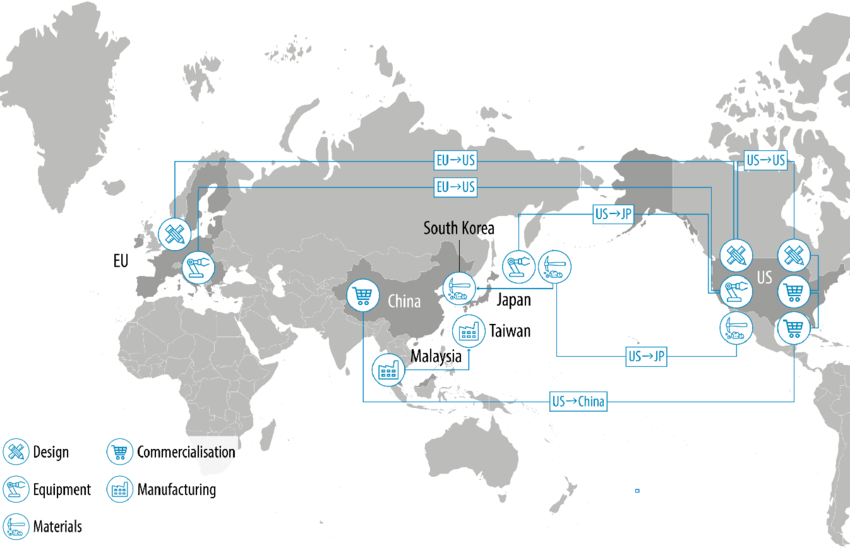
Introduction: The Global Production System Splits in Two
The international supply chain architecture built over 30 years of globalization is being re-engineered under geopolitical pressure.
The U.S.–China competition has triggered a multi-layered realignment across semiconductors, rare earths, aerospace, EV batteries, and advanced materials.
The world is moving toward two partially decoupled industrial ecosystems.
1. Semiconductors: The Core Battleground
Semiconductors sit at the heart of great power competition:
- U.S. and allied export controls limiting China’s access
- China’s push for indigenous fabs and lithography
- Taiwan and Korea reassessing risk exposure
- Japan and the Netherlands controlling equipment choke points
The CHIPS Act in the U.S. and Europe’s Chips Act mark the largest industrial policy efforts since the Cold War.
2. Rare Earths and Advanced Materials: The Hidden Pressure Points
Rare earths, gallium, germanium, advanced magnets, and aerospace composites are now strategic commodities.
- China weaponizes export permits
- The U.S., EU, and Japan build alternative extraction and processing hubs
- Australia, Canada, and Vietnam emerge as “friend-shoring” partners
The result is a new resource geopolitics for the tech age.
3. China’s Outbound FDI Surge Through the Belt and Road
Facing Western scrutiny, China deploys a parallel strategy:
- Shifting manufacturing capacity to Southeast Asia, Africa, Middle East
- Securing minerals and logistics in Global South states
- Building “shadow supply chains” to bypass export controls
This allows Beijing to maintain global reach while reducing exposure to Western leverage.
4. Western Indo-Pacific “Friend-Shoring” Networks
The U.S., Japan, Korea, Taiwan, and Australia are constructing resilient industrial networks:
- Joint semiconductor supply corridors
- Shared defense production (missiles, drones, radars)
- Critical minerals agreements
- Maritime security for supply routes
This marks the rise of a geo-industrial alliance system, not just a military alliance.
5. The Permanent Restructuring of Global Value Chains
This realignment is structural:
- Higher redundancy
- More regionalization
- More security-driven production
- Less efficiency, more resilience
Companies and states now design supply chains around political risk, not cost.
Conclusion
The global supply chain system is shifting into a new phase defined by great power rivalry, industrial security, and technological sovereignty.
Leave a Reply