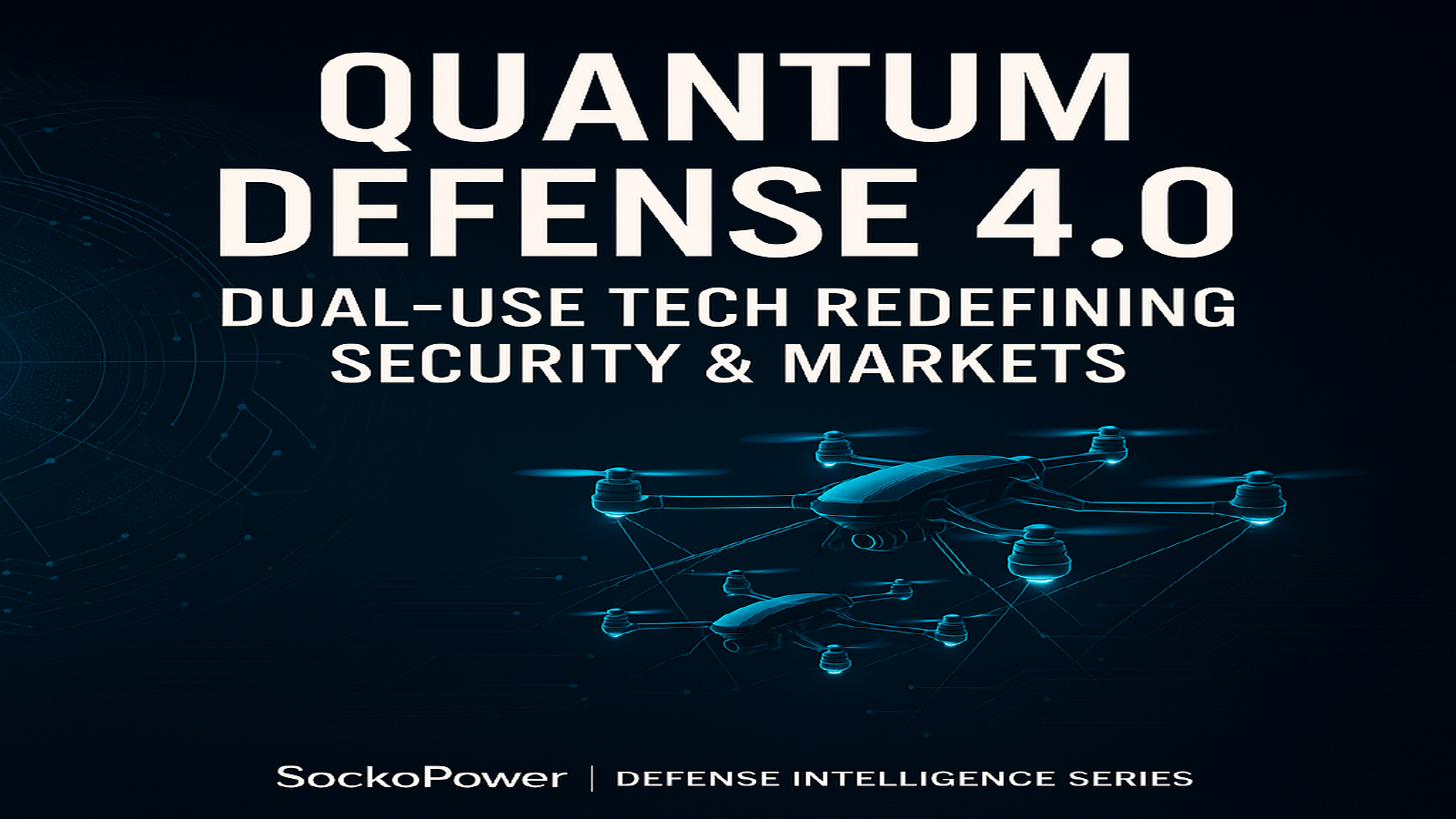
The next great power competition will not be fought by tanks or missiles, but by algorithms.
Quantum-resistant encryption, quantum radar, drone swarm optimization, and nuclear detection modeling
are no longer isolated defense projects—they are the backbone of a new dual-use economy where security and markets converge.
1. Quantum-Resistant Encryption — Securing the Post-Quantum Economy
As quantum computing threatens to break classical cryptography, global enterprises are shifting toward
Post-Quantum Cryptography (PQC). Algorithms such as CRYSTALS-Kyber and CRYSTALS-Dilithium,
standardized by NIST, are already being tested in NATO’s defense communication networks.
Beyond military use, PQC is quietly becoming the infrastructure for financial systems, cloud networks, and the IoT ecosystem.
Market Applications
- Finance: PQC-based digital signature frameworks for transaction security
- Cloud: Quantum-safe key management services from AWS and Azure
- IoT: Secure sensor networks derived from defense-grade modules
2. Quantum Radar Simulation — The New Optics of Detection
Quantum radar leverages photon entanglement to detect stealth objects that evade traditional radar systems.
AI-based simulations can now reconstruct target signatures from quantum noise patterns, offering detection capabilities
once considered impossible. What began as a military project is now influencing civilian aerospace,
space surveillance, and next-gen navigation sensors.
Market Applications
- Aviation Security: Transparent material scanners based on quantum interference
- Satellite Systems: Hybrid radar-photon phase sensors for orbital tracking
- Autonomous Mobility: Quantum-enhanced distance mapping for autonomous vehicles
3. Drone Swarm Optimization — Collective Intelligence as a Force Multiplier
AI-driven drone swarms form self-organizing networks that execute missions autonomously.
DARPA’s OFFSET program is pioneering urban-combat swarm protocols that can adapt to dynamic environments.
These same algorithms are migrating into the civilian sector, powering logistics, precision agriculture,
and disaster-response networks.
Market Applications
- Logistics: Route optimization for delivery drones
- Disaster Response: Autonomous search-and-rescue formations
- Agritech: AI-based crop monitoring and pest control swarms
4. Nuclear Material Detection Modeling — AI for Invisible Threats
Detecting illicit nuclear material relies increasingly on AI-based neutron scattering models
that identify unique particle-interaction patterns. MIT Lincoln Laboratory and the IAEA are developing
simulation platforms that reduce detection errors by over 30%.
Defense applications aside, this technology is now entering the domains of energy,
medical radiation safety, and industrial monitoring.
Market Applications
- Port Security: Automated container scanning for radiological materials
- Healthcare: AI-driven radiation diagnostics and safety analytics
- Energy: Smart monitoring for nuclear fuel management
Conclusion — From Defense Tech to Market Intelligence
The frontier between national defense and commercial innovation has disappeared.
Each of these technologies—quantum, AI, swarm systems, nuclear modeling—serves both as a weapon
and as a market platform. Defense technology has become the invisible engine of
the 21st-century economy: the line between security and profit no longer exists.
SockoPower | Defense & Market Intelligence Series, Vol. 1
References
- NIST PQC Standardization Project — CRYSTALS-Kyber / Dilithium (2024)
- DARPA OFFSET Program Overview (2023)
- MIT Lincoln Laboratory — AI-Based Nuclear Detection Models (2024)
- China NUDT — Quantum Radar Simulation Reports (2023)
- IAEA Technical Paper — Radiation Pattern Recognition for Security (2024)
Leave a Reply