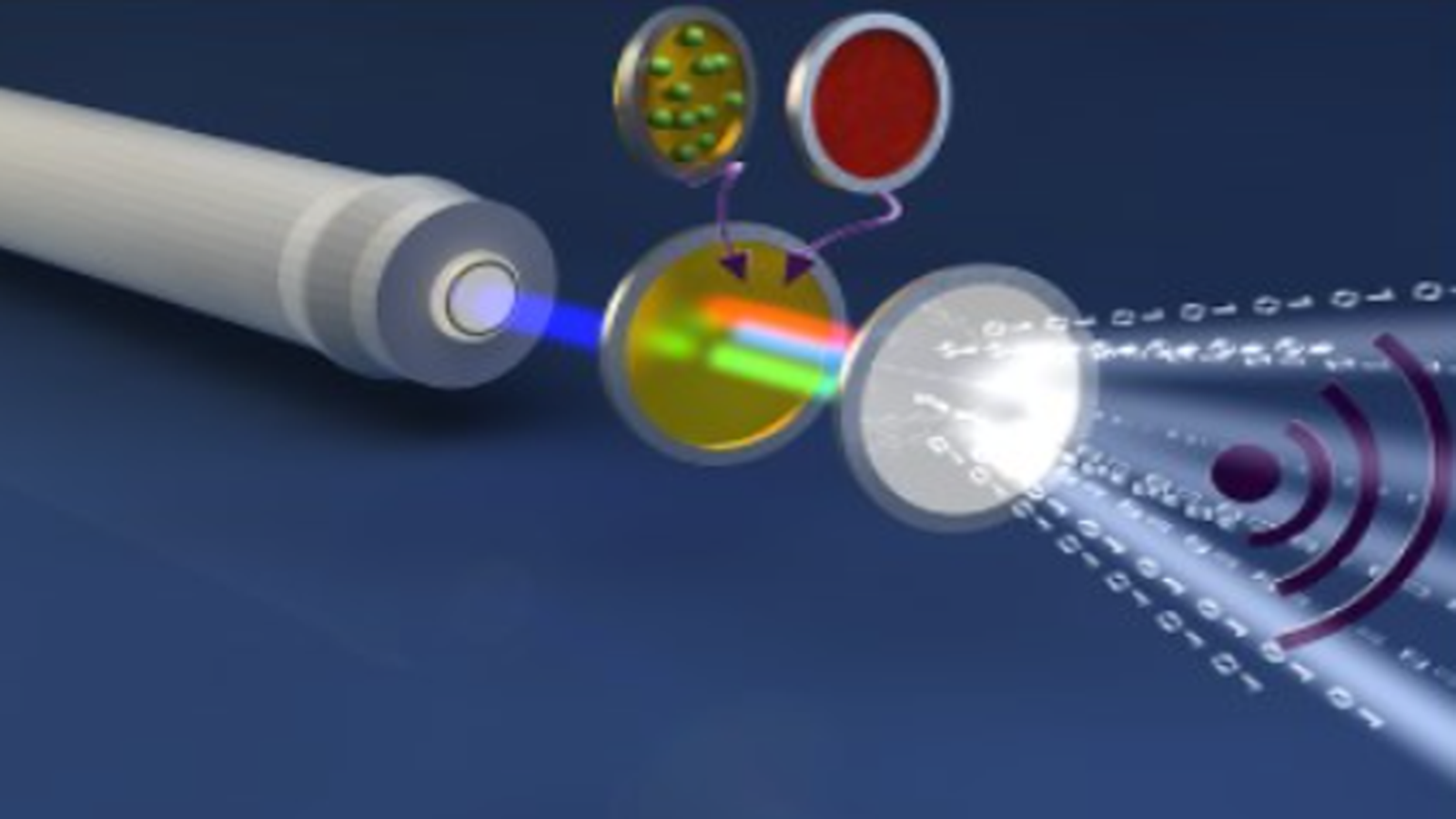
Li-Fi (Light Fidelity) is a bidirectional, high-speed wireless communication technology that uses Visible Light Communication (VLC), or infrared light, instead of radio frequency (RF) waves for data transmission.1
Here are the high-tech specifications and an overview of its business prospectus and markets:
High-Tech Specifications
| Feature | Li-Fi Specification / Characteristic | Comparison to Wi-Fi |
| Medium | Visible light (LEDs, up to $\sim 400$ to $800$ THz) and near-infrared light. | Radio Frequency (RF) waves (typically $2.4$ GHz, $5$ GHz, and $6$ GHz). |
| Speed (Theoretical) | Can reach up to 224 Gbps (Gigabits per second) in lab conditions. | Up to $\sim 9.6$ Gbps (Wi-Fi 6/6E). |
| Speed (Real-World) | Demonstrations often show $\sim 1$ Gbps or higher. | Varies greatly, often much lower than theoretical peak. |
| Bandwidth | Visible light spectrum is 10,000 times larger than the entire radio spectrum. | Limited and increasingly congested RF spectrum. |
| Security | Highly secure because light cannot penetrate opaque walls, confining the signal to a physical space. | RF signals penetrate walls, making them susceptible to interception outside the space. |
| Range | Shorter range ($\sim 10$ meters) and generally requires line-of-sight (though reflections can work). | Longer range ($\sim 32$ meters or more). |
| Interference | Interference-free from RF, making it suitable for sensitive environments. | Susceptible to interference from other electronic devices and Wi-Fi networks. |
| Infrastructure | Integrates with existing LED lighting infrastructure. | Requires dedicated Wi-Fi access points and routers. |
| Standard | Officially recognized by the IEEE 802.11bb standard, promoting interoperability. | Governed by various IEEE 802.11 standards. |
Business Prospectus and Markets
Li-Fi is not typically seen as a complete replacement for Wi-Fi but as a complementary technology that offers advantages in specific, demanding environments.2 The market is projected for significant growth, with some forecasts showing a Compound Annual Growth Rate (CAGR) of over 40-50% through the forecast period (ending around 2030-2034).3
Key Market Drivers:
- Growing demand for high-speed, high-bandwidth wireless communication.4
- Increasing RF spectrum congestion and the need for alternative, unlicensed spectrum.5
- Need for highly secure wireless connections in sensitive sectors.
- Expansion of smart cities and the ubiquity of LED lighting infrastructure.
Target Markets and Applications:
| Market Segment | Li-Fi Value Proposition |
| Defense & Government | Military-grade security and anti-jamming capabilities, as light is contained and has a near-zero electromagnetic (EM) signature. |
| Aviation & Aerospace | Interference-free high-speed passenger and avionics data, as light doesn’t disrupt sensitive RF systems. |
| Healthcare | Secure, interference-free networking for operating rooms and medical equipment (e.g., MRI machines) where RF is restricted. |
| Industrial/Manufacturing | Reliable, low-latency communication for Industrial IoT (IIoT), automation, and real-time data transmission in factory floors. |
| Retail & Indoor Networking | High-speed internet access and location-based services (e.g., product information, promotions) through smart in-store lighting. |
| Underwater Communication | Light waves travel better through water than radio waves, enabling high-speed data transfer for divers and submarines. |
| Smart Cities & Transportation | Vehicle-to-Vehicle (V2V) and Vehicle-to-Infrastructure (V2I) communication using headlights, streetlights, and traffic signals. |
Challenges:
- Line-of-Sight Requirement: While reflections can work, direct light or reflected light is generally required, limiting mobility outside the light cone.
- Inability to penetrate walls: This is a security advantage but a coverage disadvantage for whole-building mobility.
- High Initial Implementation Cost compared to existing Wi-Fi infrastructure.10
- Limited User Awareness and Compatibility: Most current devices require a Li-Fi dongle or integrated receiver.
(Source)
1. ResearchGate/www.researchgate.net/Review on Li-Fi: The Next Generation Wi-Fi – ResearchGate: On the other side of the spectrum, there lies LiFi. LiFi, which means Light Fidelity, is an emerging piece of technology that makes. use of Visible Light …
2. Lingaya’s Vidyapeeth/www.lingayasvidyapeeth.edu.in/Li-Fi Technology – The Revolutionary Wi-Fi – Lingaya’s Vidyapeeth/Aviation and Underwater Communication: In environments where radio frequency communication faces challenges, such as aircraft cabins and underwater operations, …
3. Mordor Intelligence/www.mordorintelligence.com/Light Fidelity (Li-Fi) Market Size, Share, Forecast & Analysis – Mordor Intelligence/Study Period. 2019 – 2030. Market Size (2025) USD 1.25 Billion. Market Size (2030) USD 7.73 Billion. Growth Rate (2025 – 2030) 43.96% CAGR. Fastest Growing …
4. Data Bridge Market Research/www.databridgemarketresearch.com/Global Li-Fi Market Size, Share, and Trends Analysis Report – Industry Overview and Forecast to 2032/The market growth is largely fuelled by the increasing demand for high-speed wireless communication, rising concerns regarding radio frequency spectrum …
5. Emergen Research/www.emergenresearch.com/Li-Fi Market – Emergen Research/Li-Fi is an advanced Wi-Fi-like system with a bandwidth of 224 gigabytes per second, which is relatively faster than Wi-Fi. Growing demand for highly secure …
Socko/Ghost
Leave a Reply