Tag: us-china rivalry

  • TSMC, Foxconn & ST Engineering: How Indo-Pacific Supply Chain Diversification Is Reshaping Critical Technology Networks

    TSMC, Foxconn & ST Engineering: How Indo-Pacific Supply Chain Diversification Is Reshaping Critical Technology Networks

    In the Indo-Pacific theater, the long-running U.S.–China rivalry is no longer a diplomatic abstraction. It has become a powerful driver of corporate strategy and industrial supply chain restructuring, particularly for firms with exposure to semiconductors, electronics manufacturing, and defense technologies.

    The regional diversification of supply chains reflects more than geopolitical signaling. Companies with strategic technologies are being compelled to rebalance production footprints, secure alternative sourcing, and reduce dependencies on China-centered networks—a shift that is now influencing capital flows and competitive positioning across global markets. trendsresearch.org+1

    TSMC (Taiwan Semiconductor Manufacturing Company): From Risk Zone to Strategic Hub

    The world’s most advanced logic chips are overwhelmingly produced by Taiwan Semiconductor Manufacturing Company. A recent disruption—such as the April 2024 earthquake that briefly shuttered TSMC facilities—highlighted how concentrated semiconductor output can imperil global technology supply chains. saisreview.sais.jhu.edu

    To mitigate such systemic risk, TSMC is expanding fabrication capacity in Japan and the United States, and accelerating investments in India. These moves reflect a broader industry trend in which major chipmakers pursue a “China+1” diversification strategy—maintaining existing bases while building alternative capacity outside China. trendsresearch.org

    The strategic implication is clear:
    TSMC’s production realignment enhances its resilience but also strengthens the technological autonomy of U.S. allies and partners in the Indo-Pacific. That, in turn, embeds TSMC deeper into defense and critical infrastructure supply networks—far beyond its commercial consumer electronics market.

    Foxconn: Diversifying Electronics Manufacturing Beyond China

    Another pivotal player is Foxconn, known for assembling iPhones and other consumer devices. Foxconn has significantly shifted capacity toward India and Southeast Asia, driven by rising labor costs in China, U.S.–China trade tensions, and customer demand for supply-chain resiliency.

    This “China-plus-regionalization” strategy not only hedges geopolitical risk but also positions Foxconn as a key partner to global OEMs seeking industrial footprints aligned with Western and Indo-Pacific trade frameworks. trendsresearch.org

    For Foxconn, such diversification is not purely defensive. It offers competitive leverage with major Western customers and opens access to new markets in India, ASEAN, and beyond—turning supply-chain reform into revenue growth.

    ST Engineering: Building Defense and Tech Production in Emerging Indo-Pacific Centers

    In defense and integrated systems, Singapore’s ST Engineering exemplifies a strategic response to the evolving supply landscape. Leveraging its diversified portfolio across digital, land, air, and sea domains, ST Engineering has expanded in-country production arrangements with partners such as Kazakhstan and other Indo-Pacific states. wikipedia

    This approach reflects a broader shift away from centralized manufacturing toward regionally distributed value chains that align with political risk profiles and alliance structures. For ST Engineering, this means securing production capacity in multiple jurisdictions, reducing vulnerability to regional disruptions, and embedding itself more deeply in allied defense ecosystems.

    Rare Earths and Critical Inputs: The Case of Vulcan Elements

    Beyond final assembly, critical inputs such as rare earth magnets are increasingly in focus. Vulcan Elements, a U.S. rare earth magnet producer, recently secured a major Department of Defense-backed loan to expand domestic output—explicitly aimed at reducing dependence on foreign mineral supply chains that China dominates. wikipedia

    This illustrates how supply-chain diversification now reaches raw materials and strategic components, not just finished goods. Companies that can localize or regionalize such critical nodes gain both market and geopolitical leverage.

    The Broader Strategic Realignment

    The corporate strategies of TSMC, Foxconn, ST Engineering, and Vulcan Elements underscore a larger pattern:

    • Partial decoupling of China-centric supply chains in critical technologies is underway. Asian Journal of Peacebuilding Vol. 10 No. 2 (2022)
    • Alternative production hubs—India, Southeast Asia, Japan, and U.S./Europe partnerships—are rapidly gaining traction. trendsresearch.org
    • Indo-Pacific nations pursue multi-alignment strategies, balancing ties with the U.S., China, and other partners to extract economic benefits while managing risk. Pacific Forum

    This realignment is not merely defensive. It is reshaping capital allocation, industrial specialization, and strategic influence in global technology sectors.

    Strategic Implications

    For investors and corporate planners, the implications are profound:

    1. Future value will be concentrated among firms that operationalize diversification early.
      Firms that embed supply-chain resilience into their core business models capture both market share and strategic partnerships.
    2. Geopolitical alignment shapes technology ecosystems.
      Companies must choose where to build capacity based on alliance frameworks and regulatory environments—not just pure cost metrics.
    3. Critical technology networks will bifurcate.
      One set oriented toward U.S. and allied markets, another toward China and its partners.

    In the Indo-Pacific economic order, supply-chain strategy is a strategic asset—no less than intellectual property or brand equity.

    Socko/Ghost

    In the Indo-Pacific, supply-chain strategy has become geopolitical strategy—and the winners will be those who can localize critical tech networks faster than rivals can disrupt them.
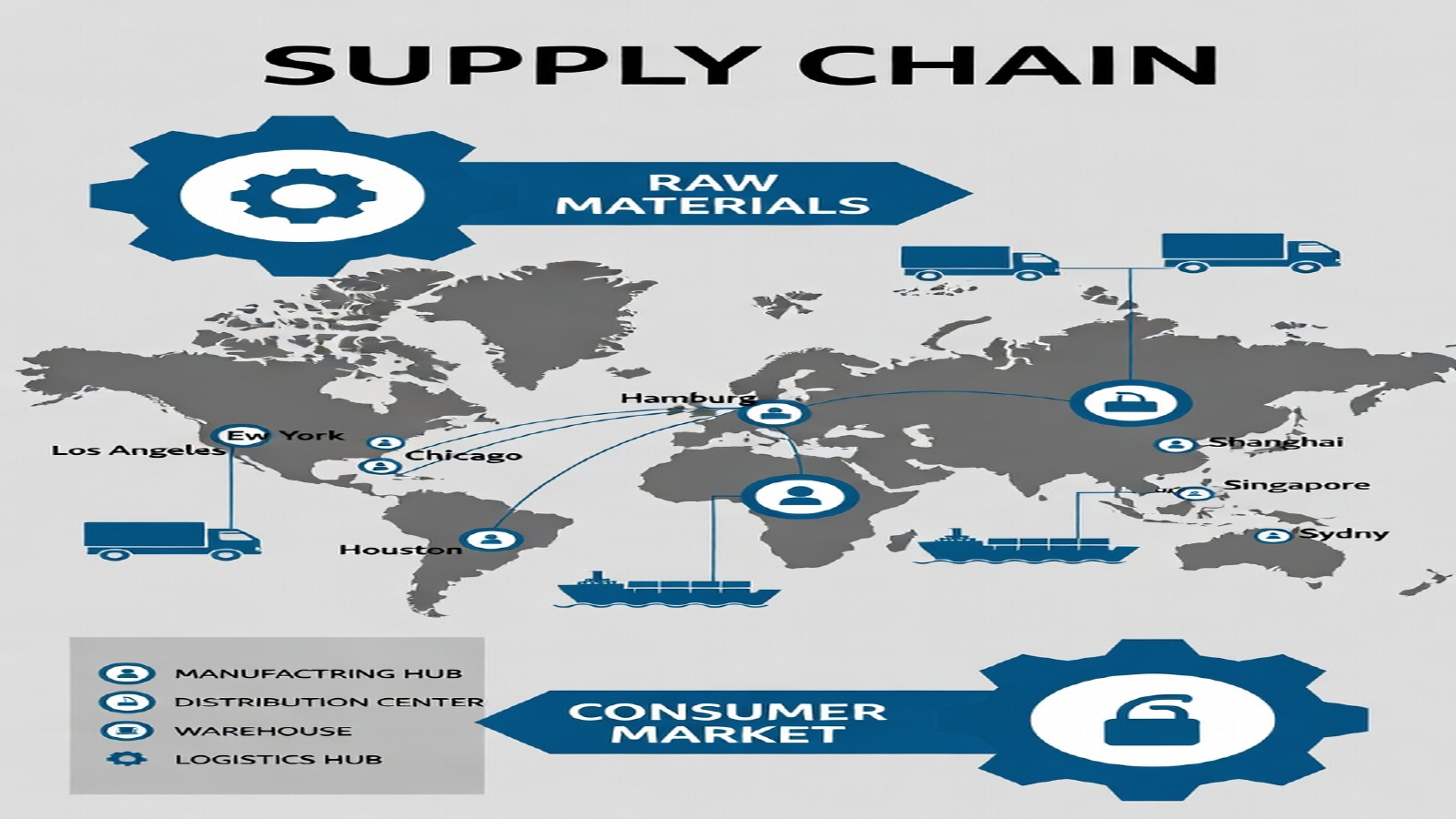

  • Supply Chain Vulnerabilities and Strategic Power Shifts in a Multipolar Global Economy

    Supply Chain Vulnerabilities and Strategic Power Shifts in a Multipolar Global Economy

    How Fragmented Production Networks Are Rewriting Global Power and Military Readine

    In the 21st century, supply chains have evolved far beyond commercial logistics. They now function as ‘sovereign assets’, and the ability to command or disrupt them directly shapes geopolitical leverage, military readiness, and the hierarchy of global governance. Accelerating protectionism, intensifying U.S.–China rivalry, and climate-induced disruptions are dismantling the old model of “low-cost, hyper-efficient globalization,” replacing it with a harsher system of strategic competition.

    1. The Fragmentation of the ‘Intermediate Goods World’

    Geopolitics has seized control of production networks.

    Over 70% of global trade consists of intermediate goods crossing multiple borders before reaching final assembly. This means that any disruption—anywhere—can immobilize entire industries.

    Recent shocks include:

    • U.S.–China semiconductor and AI export controls
    • Apple, Tesla, and major logistics firms accelerating “China-plus-one” exits
    • Red Sea attacks forcing up to 40% of container traffic to reroute
    • Grain and fertilizer shortages triggered by the Russia–Ukraine war

    The pattern is unmistakable:
    Geopolitical pressure has overtaken economic logic as the main driver of supply chain behavior.

    2. The Era of ‘Weaponized Supply Chains’

    States are now more powerful than multinational corporations.

    Where corporations once designed supply chains and governments merely regulated them, the power structure has flipped. Nations now treat supply networks as strategic weapons.

    United States

    • CHIPS and Science Act: semiconductors become defense infrastructure
    • Inflation Reduction Act: restructuring of minerals and battery supply chains
    • Integration of commercial and defense industrial bases for dual-use capability

    China

    • Export controls on rare earths, gallium, germanium, graphite
    • Use of strategic materials as diplomatic leverage
    • Expansion of South China Sea logistics and maritime choke-point control

    European Union

    • Critical Raw Materials Act
    • Diversification into Africa, Latin America, and the Arctic
    • Strategic autonomy efforts in energy, tech, and defense

    The result:
    Supply chain control has become a form of 21st-century coercive power—equal to sanctions, military bases, or currency dominance.

    3. Climate Change as an Emerging Military Variable

    Environmental instability now directly affects global force projection.

    Climate disruptions are no longer marginal. They increasingly degrade military mobility, energy logistics, and operational readiness.

    • The Panama Canal’s prolonged drought cut East–West shipping capacity
    • Middle Eastern and South Asian heat waves limit aircraft payloads
    • Melting Arctic routes are transforming the region into a new front for Russia, China, and NATO

    Climate instability is reshaping both commercial logistics and the strategic geography of warfare.

    4. Military Readiness Is Now Supply-Chain Dependent

    Wars are decided by throughput, not just firepower.

    The Ukraine war exposed how fast modern militaries burn through ammunition and components:

    • NATO’s artillery and missile stockpiles depleted far faster than expected
    • The U.S. drew on Korean and Japanese inventories to backfill shortages
    • China’s dominance in drones, batteries, and critical minerals highlighted its wartime industrial advantage

    The Pentagon now defines the defense industrial base as “the first line of deterrence.”
    A conflict can only last as long as the supply chain beneath it survives.

    5. Winners and Losers in the Multipolar Supply-Chain Order

    Real power is shifting—not through GDP, but through chokepoints and production sovereignty.

    United States

    Maintains global leadership via semiconductors, advanced manufacturing, defense production, and allied industrial coalitions.

    China

    Holds asymmetric leverage through rare earths, mid-stream manufacturing, and battery technologies—its “black-leverage” advantage.

    India & Southeast Asia

    Become the major beneficiaries of diversification away from China; new hubs for electronics, logistics, and heavy manufacturing.

    Japan & South Korea

    Strengthen their roles as indispensable nodes in semiconductors, batteries, shipbuilding, and next-generation defense systems.

    Multinational Corporations

    Transition from “stateless global actors” to politically constrained operators navigating sanctions, export controls, and alliance-based ecosystems.
    They no longer choose sites based on cost—but on geopolitical survivability.

    Conclusion — The State That Controls Supply Chains Controls the Future

    Economic, military, technological, and climate systems are merging into a single competitive domain. Power is no longer measured only by armies or reserves, but by the ability to reshape, protect, and weaponize supply chains.

    • Supply chains = peacetime leverage
    • Sanctions = wartime pressure
    • Chips & critical minerals = strategic sovereignty
    • Climate disruptions = force-projection constraints
    • Logistics realignment = the new map of global power

    In this multipolar era, the winners are the states and corporations that can rapidly reconfigure supply chains under pressure while maintaining technological and military resilience.

    This is the battlefield that will define global order—SockoPower is tracking it at the center of the map.

    References

    • Council on Foreign Relations. Global Supply Chain Pressure Index, 2023–2025.
    • U.S. Department of Defense. National Defense Industrial Strategy (NDIS), 2024–2025.
    • European Commission. Critical Raw Materials Act Briefing, 2024.
    • IMF. Geoeconomic Fragmentation and Supply Chain Resilience, 2024.
    • McKinsey Global Institute. Reimagining Supply Chains in a Fragmented World, 2023.
    • RAND Corporation. Industrial Base Dependencies and Military Readiness, 2024.
    • CSIS. Weaponized Interdependence in the Indo-Pacific, 2024.
  • Strategic Decoupling & Supply Chain Fragmentation

    Strategic Decoupling & Supply Chain Fragmentation

    Geopolitics is no longer about territory — it is about who controls the technology stack that powers nations.

    The rivalry between major powers is pushing global supply chains toward fragmentation and regional tech ecosystems with distinct standards, components, and regulations.

    1. Export Controls as Strategic Weapons

    The U.S., EU, and Japan are restricting exports of:

    AI chips

    Quantum hardware

    Advanced lithography

    Military-grade sensors

    These controls slow adversaries’ military modernization and create two incompatible tech universes.

    2. China’s Push for Autonomous Tech Ecosystems

    China is accelerating domestic production of:

    Semiconductors

    UAV systems

    Rare-earth refining

    Advanced materials

    This reduces vulnerability to Western chokepoints while expanding influence across Belt-and-Road trade corridors.

    3. Indo-Pacific & European Realignments

    Nations caught in the middle are choosing sides based on:

    Defense treaties

    Trade dependencies

    Technology access

    Supply chain resilience

    This realignment is producing new economic blocs that operate on competing technical standards.

    4. Long-Term Impact

    Strategic decoupling will:

    Redesign global manufacturing

    Fragment digital trade

    Force companies to operate dual supply chains

    Increase geopolitical risk premiums

    The world is entering a period of permanent supply chain bifurcation.

    Bottom Line

    Civil-military tech competition is reshaping the global economy.
    Supply chains are no longer neutral — they are geopolitical assets.

    References

    WTO Global Value Chain Fragmentation Study

    U.S. Commerce Department Export Control Briefings

    EU Strategic Autonomy Framework

    Asia Pacific Foundation: Tech Bloc Formation Analysis