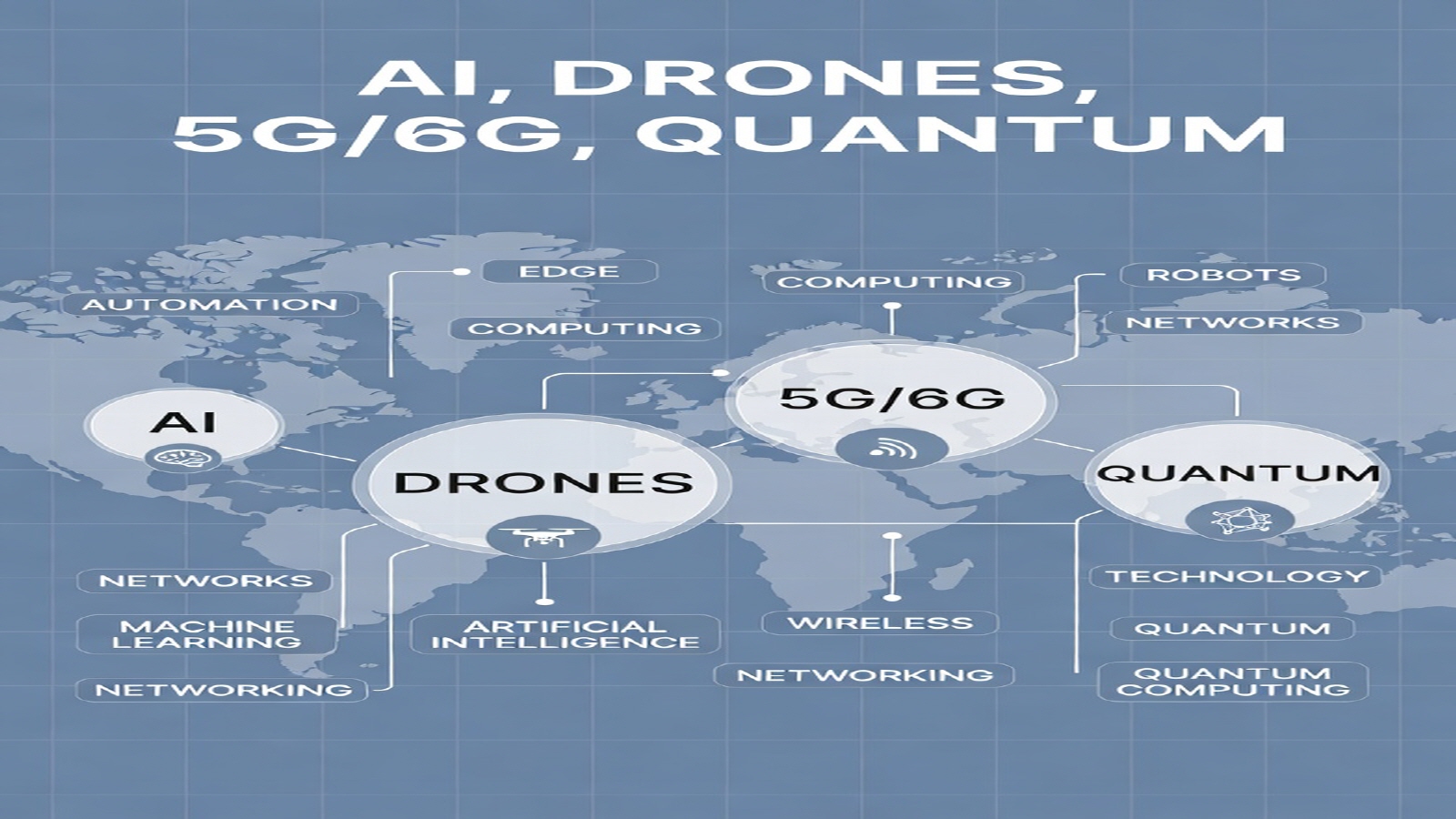
The 21st-century battlefield is increasingly shaped not by tanks, missiles, or aircraft, but by technologies originally developed for civilian markets—AI, autonomous robotics, satellite-enabled communications, and quantum computing. What once existed as separate technological domains is converging into a single, dual-use ecosystem where civilian innovation directly fuels military capability.
This civil–military fusion (CMF) is fundamentally reshaping global power projection, particularly among the United States, China, and Russia.
The nations that dominate dual-use technology pipelines will shape the future of deterrence, conflict, and geopolitical hierarchy.
1. Dual-Use Innovation Has Become the New Arms Race
Commercial tech is now military infrastructure.
Artificial intelligence, advanced chips, hyperscale cloud computing, and high-speed mobile networks were never designed as weapons. Yet they now form the backbone of:
autonomous drones
AI-enhanced ISR (intelligence, surveillance, reconnaissance)
predictive logistics
cyber operations
hypersonic command systems
multi-domain operational networks
The line separating Silicon Valley startups from defense contractors has vanished.
The military of the future is built on commercial innovation.
2. AI and Autonomous Systems: The Core of Next-Generation Power Projection
Autonomy = speed. Speed = dominance.
AI-driven autonomous systems—from drone swarms to automated cyber defense—are redefining military decision cycles.
United States
DARPA’s ACE program for AI dogfighting
Navy’s Ghost Fleet Overlord autonomous vessels
Joint All-Domain Command and Control (JADC2) integration
China
Civil–military fusion doctrine accelerating dual-use AI
Mass production of low-cost autonomous drone platforms
Strategic AI labs built on commercial tech giants (Baidu, Alibaba, Tencent)
Russia
Autonomous loitering munitions
AI-assisted artillery targeting using battlefield sensors
Heavy reliance on civilian drones modified for warfare
Autonomy compresses the “OODA loop”—observe, orient, decide, act—creating a new currency of military advantage: machine-speed warfare.
3. 5G/6G and the Battle for Electromagnetic Dominance
Connectivity itself becomes a weapon.
Modern militaries depend on massive data throughput:
drone swarm coordination
satellite–ground communication
real-time logistics
command-and-control
autonomous navigation
5G enabled this shift; 6G will accelerate it to near-lightning levels.
U.S. strategy:
Integrate 5G/6G into secure battlefield networks, leveraging private-sector leadership.
China’s strategy:
Use global 5G/6G infrastructure as geopolitical leverage, embedding influence across Asia, Africa, Europe, and Latin America.
Russia strategy:
Focus on electronic warfare dominance rather than broad consumer networks.
5G/6G is not just commerce—it is information dominance, the foundation of modern power projection.
4. Quantum Computing and Secure Communications: The Coming Strategic Shock
Quantum supremacy will rewrite cyber warfare.
Quantum technology threatens to disrupt the core of national security:
encryption cracking
ultra-secure quantum communication networks
quantum-enhanced sensing for submarine and stealth tracking
new forms of electronic warfare
China
Has already deployed a quantum communication backbone between Beijing and Shanghai, and runs the world’s most aggressive national quantum program.
United States
Leads in private-sector quantum computing hardware and algorithms (IBM, Google, AWS), with growing DoD–industry integration.
Russia
Invests in quantum sensing and signals intelligence capabilities.
Quantum capability gaps will determine strategic survivability in the next decade.
5. The U.S.–China–Russia Triangular Tech Rivalry
Global power is no longer measured in troops but in teraflops.
United States: Innovation Dominance Strength: advanced semiconductors, cloud infrastructure, AI algorithms, defense integration. Vulnerability: manufacturing dependence on East Asia.
China: Scale + State Alignment
Strength: mass production, civil–military fusion, unified national tech strategy.
Vulnerability: access to cutting-edge lithography and high-end chips.
Russia: Asymmetric Tech Warfare
Strength: electronic warfare, missile systems, cyber operations.
Vulnerability: industrial capacity and sanctions.
The convergence of civilian and military tech has turned this rivalry into a three-dimensional race across AI, chips, quantum, and communications.
Conclusion — Civil–Military Technology Convergence Will Redefine Global Power
The future of power projection will be determined not by traditional defense spending but by:
the speed of innovation
control of advanced chips
access to global telecoms infrastructure
quantum breakthroughs
autonomous systems deployment
Nations that dominate dual-use innovation pipelines will shape everything from deterrence to alliance structures.
Civilian technology is now the battlefield.
The global balance of power will be rewritten there.
References
CSIS. Civil–Military Fusion and Strategic Competition, 2024.
RAND. AI-Driven Warfare and Autonomous Systems, 2023–2024.
U.S. DoD. Emerging Technologies and National Defense Strategy, 2024.
Chinese Academy of Sciences. Quantum Communication Progress Report, 2024.
NATO CCDCOE. Multi-Domain Operations and 5G/6G Integration, 2024.
Oxford Future of Humanity Institute. Dual-Use AI & Global Security, 2024.