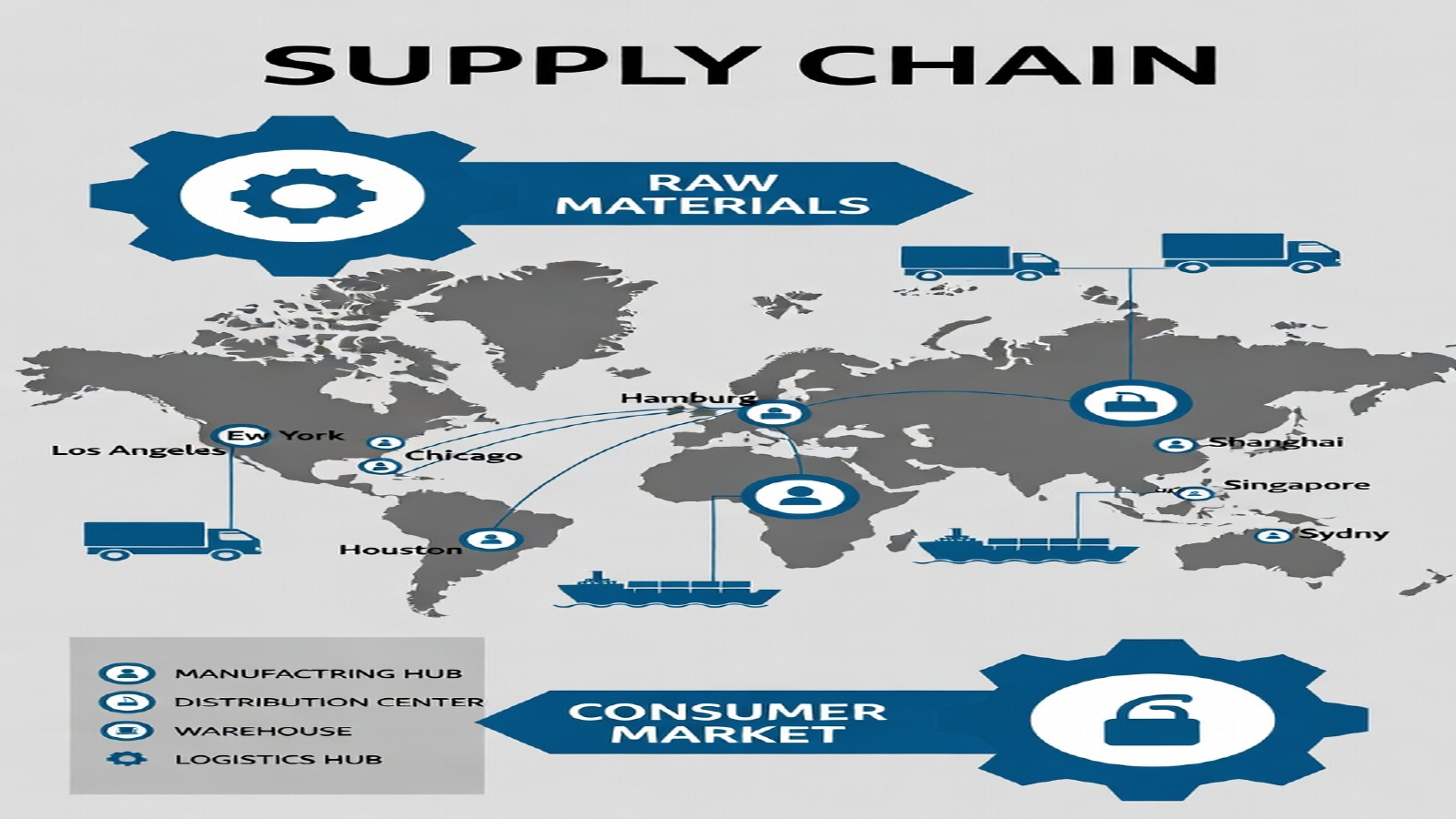
How Fragmented Production Networks Are Rewriting Global Power and Military Readine
In the 21st century, supply chains have evolved far beyond commercial logistics. They now function as ‘sovereign assets’, and the ability to command or disrupt them directly shapes geopolitical leverage, military readiness, and the hierarchy of global governance. Accelerating protectionism, intensifying U.S.–China rivalry, and climate-induced disruptions are dismantling the old model of “low-cost, hyper-efficient globalization,” replacing it with a harsher system of strategic competition.
1. The Fragmentation of the ‘Intermediate Goods World’
Geopolitics has seized control of production networks.
Over 70% of global trade consists of intermediate goods crossing multiple borders before reaching final assembly. This means that any disruption—anywhere—can immobilize entire industries.
Recent shocks include:
- U.S.–China semiconductor and AI export controls
- Apple, Tesla, and major logistics firms accelerating “China-plus-one” exits
- Red Sea attacks forcing up to 40% of container traffic to reroute
- Grain and fertilizer shortages triggered by the Russia–Ukraine war
The pattern is unmistakable:
Geopolitical pressure has overtaken economic logic as the main driver of supply chain behavior.
2. The Era of ‘Weaponized Supply Chains’
States are now more powerful than multinational corporations.
Where corporations once designed supply chains and governments merely regulated them, the power structure has flipped. Nations now treat supply networks as strategic weapons.
United States
- CHIPS and Science Act: semiconductors become defense infrastructure
- Inflation Reduction Act: restructuring of minerals and battery supply chains
- Integration of commercial and defense industrial bases for dual-use capability
China
- Export controls on rare earths, gallium, germanium, graphite
- Use of strategic materials as diplomatic leverage
- Expansion of South China Sea logistics and maritime choke-point control
European Union
- Critical Raw Materials Act
- Diversification into Africa, Latin America, and the Arctic
- Strategic autonomy efforts in energy, tech, and defense
The result:
Supply chain control has become a form of 21st-century coercive power—equal to sanctions, military bases, or currency dominance.
3. Climate Change as an Emerging Military Variable
Environmental instability now directly affects global force projection.
Climate disruptions are no longer marginal. They increasingly degrade military mobility, energy logistics, and operational readiness.
- The Panama Canal’s prolonged drought cut East–West shipping capacity
- Middle Eastern and South Asian heat waves limit aircraft payloads
- Melting Arctic routes are transforming the region into a new front for Russia, China, and NATO
Climate instability is reshaping both commercial logistics and the strategic geography of warfare.
4. Military Readiness Is Now Supply-Chain Dependent
Wars are decided by throughput, not just firepower.
The Ukraine war exposed how fast modern militaries burn through ammunition and components:
- NATO’s artillery and missile stockpiles depleted far faster than expected
- The U.S. drew on Korean and Japanese inventories to backfill shortages
- China’s dominance in drones, batteries, and critical minerals highlighted its wartime industrial advantage
The Pentagon now defines the defense industrial base as “the first line of deterrence.”
A conflict can only last as long as the supply chain beneath it survives.
5. Winners and Losers in the Multipolar Supply-Chain Order
Real power is shifting—not through GDP, but through chokepoints and production sovereignty.
United States
Maintains global leadership via semiconductors, advanced manufacturing, defense production, and allied industrial coalitions.
China
Holds asymmetric leverage through rare earths, mid-stream manufacturing, and battery technologies—its “black-leverage” advantage.
India & Southeast Asia
Become the major beneficiaries of diversification away from China; new hubs for electronics, logistics, and heavy manufacturing.
Japan & South Korea
Strengthen their roles as indispensable nodes in semiconductors, batteries, shipbuilding, and next-generation defense systems.
Multinational Corporations
Transition from “stateless global actors” to politically constrained operators navigating sanctions, export controls, and alliance-based ecosystems.
They no longer choose sites based on cost—but on geopolitical survivability.
Conclusion — The State That Controls Supply Chains Controls the Future
Economic, military, technological, and climate systems are merging into a single competitive domain. Power is no longer measured only by armies or reserves, but by the ability to reshape, protect, and weaponize supply chains.
- Supply chains = peacetime leverage
- Sanctions = wartime pressure
- Chips & critical minerals = strategic sovereignty
- Climate disruptions = force-projection constraints
- Logistics realignment = the new map of global power
In this multipolar era, the winners are the states and corporations that can rapidly reconfigure supply chains under pressure while maintaining technological and military resilience.
This is the battlefield that will define global order—SockoPower is tracking it at the center of the map.
References
- Council on Foreign Relations. Global Supply Chain Pressure Index, 2023–2025.
- U.S. Department of Defense. National Defense Industrial Strategy (NDIS), 2024–2025.
- European Commission. Critical Raw Materials Act Briefing, 2024.
- IMF. Geoeconomic Fragmentation and Supply Chain Resilience, 2024.
- McKinsey Global Institute. Reimagining Supply Chains in a Fragmented World, 2023.
- RAND Corporation. Industrial Base Dependencies and Military Readiness, 2024.
- CSIS. Weaponized Interdependence in the Indo-Pacific, 2024.