Tag: isr systems

  • Palantir and Lockheed Martin: How Dual-Use AI Turned Commercial Analytics into Military Revenue

    Palantir and Lockheed Martin: How Dual-Use AI Turned Commercial Analytics into Military Revenue

    The most consequential dual-use AI deployment in today’s defense market did not originate inside a traditional weapons program.
    It emerged from a commercial data analytics companyPalantir Technologies—and was absorbed, system by system, into the world’s largest defense integrator, Lockheed Martin.

    This is not a story about artificial intelligence entering defense.
    It is a story about how civilian-scale software became militarily indispensable without becoming a weapon.

    From Commercial Analytics to Command Authority

    Palantir’s platforms were originally designed to solve civilian problems:
    financial fraud detection, logistics optimization, enterprise data integration, and large-scale pattern analysis. The core value proposition was not secrecy—it was scalability and decision acceleration.

    Those same attributes made the technology attractive to military users facing a different problem:
    how to integrate fragmented sensor data, ISR feeds, and operational reports into a single decision environment.

    Rather than building proprietary AI systems internally, Lockheed Martin increasingly positioned itself as a systems integrator, embedding Palantir’s analytics layer into command-and-control, ISR, missile defense, and space-domain architectures.

    What changed was not the algorithm.
    What changed was the consequence of the output.

    The Dual-Use Revenue Structure

    The Palantir–Lockheed relationship illustrates a new defense business model:

    • Civilian markets fund scale and iteration
      Commercial clients generate continuous data exposure, rapid feedback cycles, and product refinement.
    • Defense contracts fund stability and margin
      Military customers pay for long-term support, secure deployment, customization, and mission assurance.

    Palantir avoids the political and regulatory friction of being classified as a pure defense contractor, while Lockheed avoids the cost and risk of building AI capabilities from scratch. The result is a symbiotic revenue architecture—one optimized for peacetime markets and wartime relevance

    Why Lockheed Martin Did Not Build This In-House

    For traditional defense primes, AI is no longer a differentiator—it is an absorbed capability.

    Building in-house AI platforms would require:

    • Civilian data exposure they cannot legally or practically access
    • Software iteration speeds incompatible with defense procurement cycles
    • Talent competition with Silicon Valley firms operating outside classified environments

    By integrating Palantir’s platforms, Lockheed preserves its strategic position as a prime contractor while outsourcing cognitive complexity to a civilian firm whose incentives are aligned with consta

    Global Market Expansion Through Localization, Not Reinvention

    This dual-use model scales globally without replicating R&D.

    • Core analytics engines remain centralized
    • Data governance, interfaces, and compliance layers are localized
    • Allied markets receive functionally identical capability under sovereign constraints

    This allows the same AI backbone to serve:

    • Commercial clients in finance, energy, and logistics
    • Defense customers across NATO and allied Indo-Pacific states

    The technology travels.
    The liability does not.

    Strategic Implication

    The Palantir–Lockheed Martin model signals a structural shift:

    Dual-use AI is no longer a transitional phase.
    It is the default path by which civilian technology becomes military power—quietly, contractually, and profitably.

    Socko/Gho
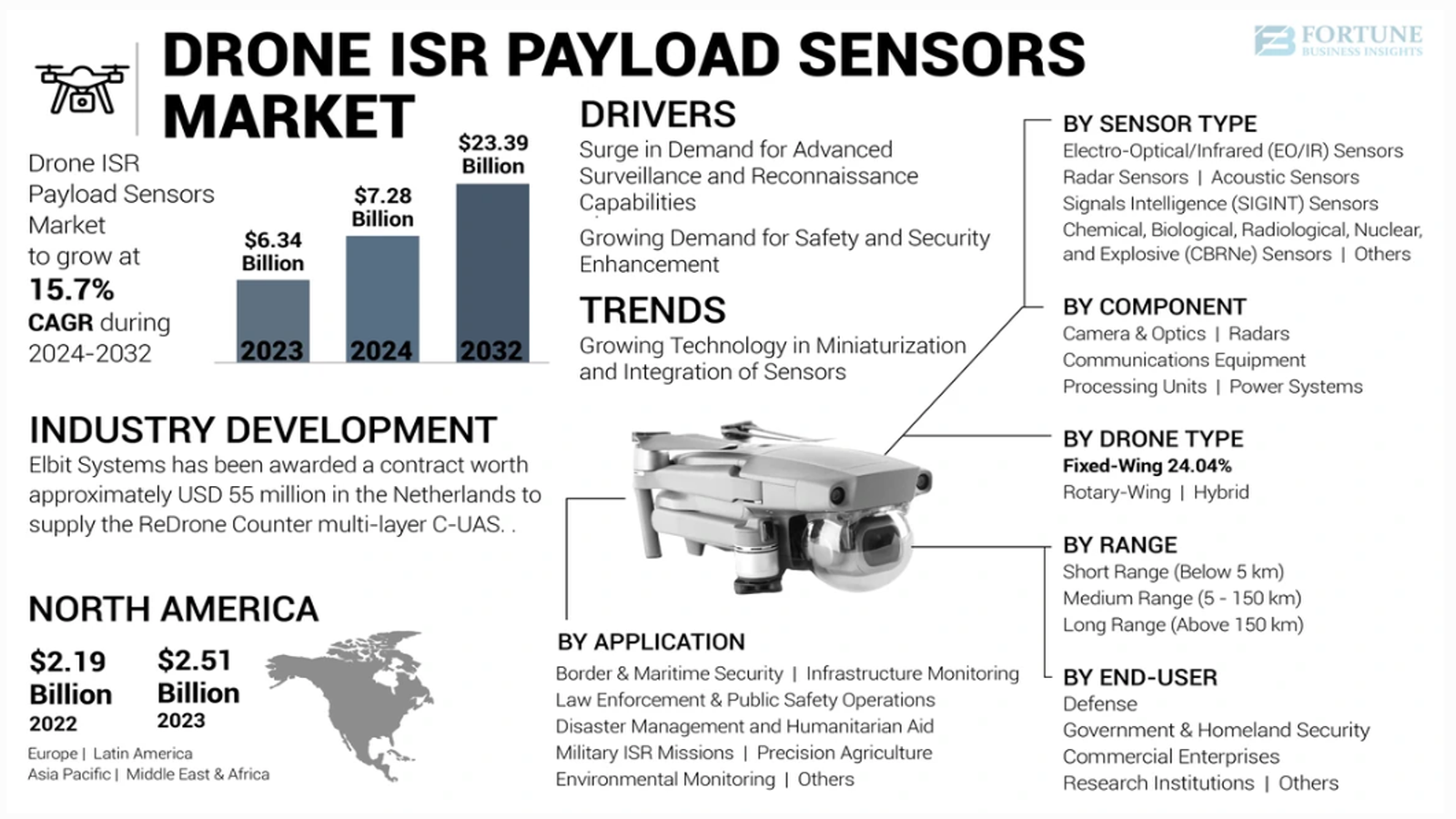
  • AI-Driven ISR Fusion: Autonomous Sensor–Targeting Networks Expanding Across Indo-Pacific and European Theaters

    AI-Driven ISR Fusion: Autonomous Sensor–Targeting Networks Expanding Across Indo-Pacific and European Theaters

    1. The New Battlespace: Where Sensors, AI, and Kill-Chains Converge

    Defense markets in 2025 are being reorganized around one dominant theme:
    AI-Driven ISR Fusion — the ability to merge satellite, aerial, maritime, cyber, and ground-sensor intelligence into a single autonomous targeting picture.

    As great-power competition intensifies, both the Indo-Pacific and Europe are shifting their procurement priorities toward systems that compress the sensor-to-shooter timeline from minutes to seconds.
    AI is no longer an “assistive tool”; it is the core orchestrator of the next-generation kill chain.

    2. Indo-Pacific: Countering China’s A2/AD With Distributed Autonomy

    China’s expanding A2/AD belts — from the South China Sea to Taiwan and the First Island Chain — are accelerating demand for:

    • Autonomous maritime ISR drones (USV/UUV swarms)
    • AI-enhanced SIGINT/ELINT processors
    • Multi-domain sensor fusion hubs linking naval, air, and space assets
    • Low-latency tactical cloud networks resilient to jamming
    • Long-range precision fires guided by machine-generated targeting

    The U.S., Japan, Australia, and South Korea are now co-developing architectures that combine real-time ISR streams + autonomous cueing to penetrate contested environments without exposing manned platforms.

    The doctrine is simple:
    Small, cheap, numerous, and AI-coordinated beats big, slow, centralized.

    3. Europe: AI ISR as the Backbone of a Post-Ukraine Defense Posture

    The Russia-Ukraine war permanently altered Europe’s procurement strategy.
    NATO now prioritizes:

    • Counter-battery AI sensors (locating artillery in seconds)
    • AI-accelerated battlefield awareness for armored formations
    • Drone-counter-drone autonomy engines
    • Satellite–drone–ground fusion centers for 24/7 targeting
    • Stand-off weapons guided by synthetic-aperture AI models

    The result is a shift away from legacy heavy platforms toward digital-first lethality where ISR accuracy determines firepower, not the size of the weapon.

    4. Key Industry Players Driving the AI-ISR Revolution

    USA

    • Palantir – real-time fusion & autonomous tasking engines
    • Anduril – Lattice OS, AI kill-chain networking, autonomous drones
    • Lockheed Martin – AI-enabled missile guidance + space ISR integration
    • Raytheon – counter-drone and AI radar suites

    Europe

    • BAE Systems – multi-domain ISR cloud architecture
    • Thales – AI radar + integrated electronic warfare
    • Airbus Defence – satellite-drone fusion ecosystems

    Asia-Pacific

    • Hanwha, LIG Nex1 (Korea) – AI-guided artillery, ISR drones, autonomous fire-control systems
    • Mitsubishi Heavy (Japan) – maritime ISR AI and next-gen Aegis integration

    The competitive frontier is no longer hardware—it is AI orchestration.

    5. Market Outlook: The Rise of Autonomous Targeting Ecosystems

    According to 2025 analyst projections:

    • Global ISR/AI fusion market: ~$72B by 2030
    • Autonomous targeting & sensor networks: CAGR 14–18%
    • Defense cloud & edge AI: fastest-growing segment (over 20% CAGR)

    Three factors drive this acceleration:

    1. Long-range precision warfare becoming standard
    2. Drones & counter-drone races escalating
    3. Multi-domain command requiring machine-speed decision cycles

    Simply put:
    Whoever fuses sensors fastest dominates the battlespace.

    6. Strategic Implication: The Kill Chain Becomes the Platform

    The era of standalone platforms is ending.
    The new battlefield is a mesh of autonomous nodes where:

    • Satellites spot
    • Edge AI classifies
    • Swarms track
    • Ground batteries shoot
    • Cloud AI re-targets
    • Everything updates in seconds

    In both Indo-Pacific flashpoints and the European front, the nation that perfects AI-driven ISR fusion secures the decisive advantage.

    References

    U.S. Department of Defense (DoD). “Joint All-Domain Command and Control (JADC2) Strategy.” 2024.

    NATO ACT. “Multi-Domain Operations and AI-Enabled ISR Integration.” NATO Allied Command Transformation Report, 2024–2025.

    RAND Corporation. “AI-Enabled ISR Fusion and Future Kill-Chain Acceleration.” RAND Defense Analysis Series, 2023–2024.

    CSIS (Center for Strategic & International Studies). “Indo-Pacific A2/AD Trends and Autonomous Systems.” CSIS Strategic Technologies Program, 2024.

    European Defence Agency (EDA). “AI for Defense, ISR, and Targeting Networks in Europe.” EDA Technical Paper, 2024.

    Air Force Research Laboratory (AFRL). “Autonomous Sensor Integration and Machine-Speed Targeting.” AFRL MDO Research Brief, 2025.

    Jane’s Defence Weekly. “Global ISR Market Outlook 2025: Satellite–Drone Fusion and Tactical Edge AI.”

    Anduril Industries. Lattice OS Technical Overview. Corporate Whitepaper, 2024.

    Palantir Technologies. “Meta-Constellation & Autonomous Tasking Architecture.” ISR Fusion Product Guide, 2024.

    BAE Systems. “Digital Battlespace ISR & AI Sensor Networks.” Technology Insights, 2024–2025.