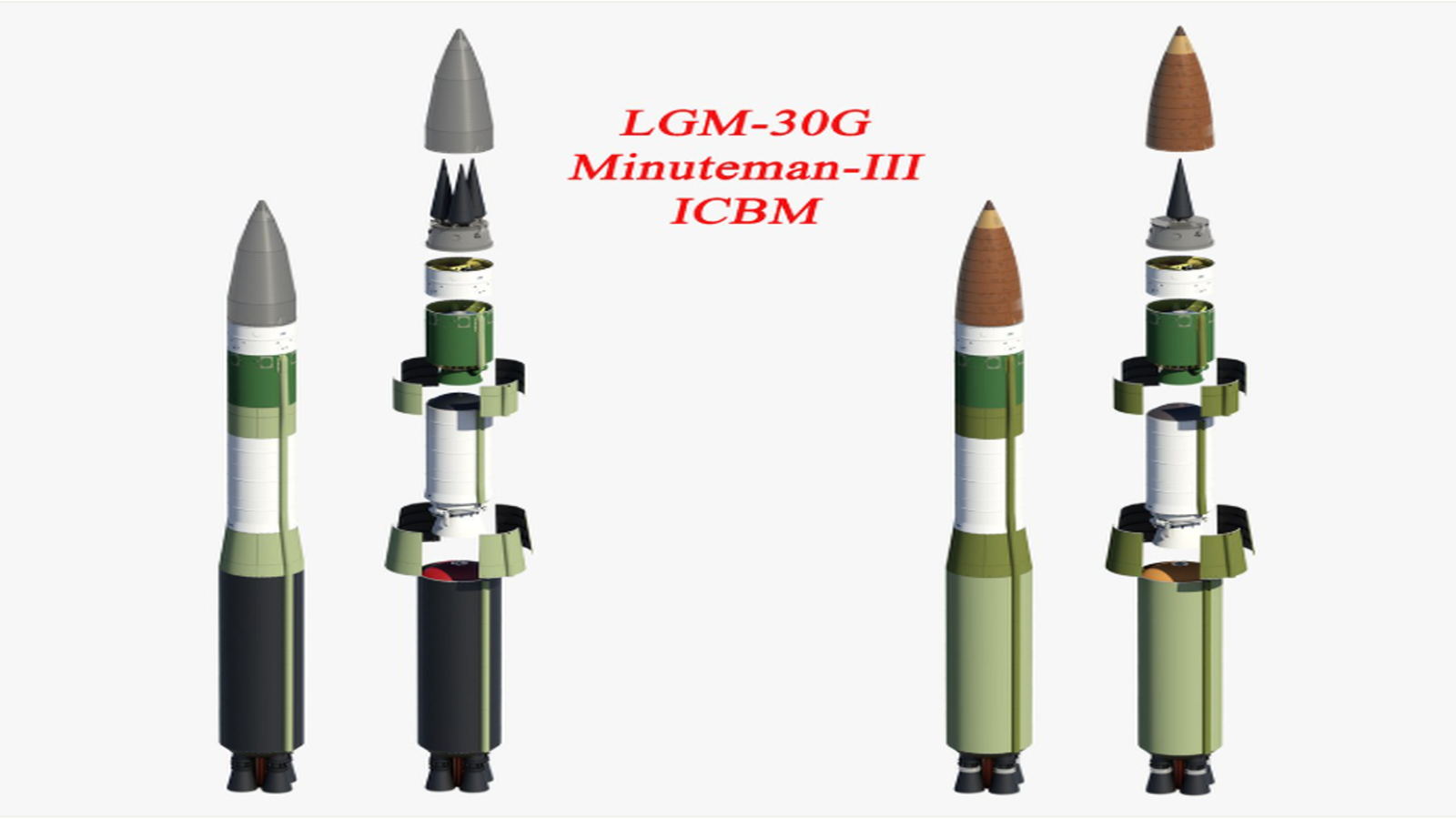
The LGM-30G Minuteman III is a three-stage, silo-launched, solid-propellant intercontinental ballistic missile that has been continually modernized since first deployed around 1970. It uses a hardened silo/command network, multi-stage solid propulsion, an onboard inertial guidance/computer system, and robust telemetry/command interfaces. Afghanistan Military+1
Key subsystems
The specs are framed for civil uses (satellite launch, sounding rockets, resilient infrastructure, precision navigation, industrial composites, and secure telemetry).
1) Inertial guidance / guidance computer (onboard navigation & control)
What it is (concept): self-contained navigation using high-precision accelerometers/gyros and an onboard computer to compute position/attitude without external references. Used in Minuteman for accurate long-range guidance. airandspace.si.edu+1
Civil applications:
- spacecraft/launcher stage guidance, sounding rockets, and small satellite attitude control.
- high-reliability inertial units for aircraft, maritime navigation, and autonomous heavy-equipment where GNSS may be denied.
- precision surveying and geodesy as an INS supplement to GNSS (dead-reckoning bridging).
Example civilian spec template (safe, non-weapon):
- Performance class: tactical INS (drift < 0.1°/hr) vs navigation INS (drift < 1°/hr) vs MEMS grade (drift measured in °/hr or m/s²).
- Position drift (dead-reckoning): target < 1 km over 1 hour (MEMS) down to < 10 m over 1 hour (high-end tactical).
- Update interfaces: standard serial/CAN/ARINC/SpaceWire + NMEA/ROS bridging.
- Environmental: operate −40°C to +70°C, shock to 300 g (packaged), vibration 5–2000 Hz.
- Reliability: MTBF >10,000 hours; ECC/CRC checked navigation logs.
- Certification targets: DO-178/ED-12 compatible software practices for safety-critical avionics; DO-160 environmental categories for hardware.
2) Rugged / radiation-hardened embedded computing & control (guidance computer concept)
What it is: hardened realtime computer(s) and flight software that run guidance, stage sequencing, health monitoring and telemetry.
Civil applications:
- small satellite flight computers, high-reliability industrial controllers (nuclear, mining), and edge controllers for remote/hardened infrastructure (underground data centers, remote launch sites).
- fault-tolerant control systems for unmanned ships/aircraft.
Example civilian spec template:
- CPU class: space-qualified or rad-tolerant single board computer (or COTS with fault-tolerance).
- RTOS with determinism: 10 ms worst-case latency (as design target).
- Interfaces: MIL-STD-1553 / CAN / UART / Ethernet (GigE/IP) for telemetry and command.
- Watchdog/failover: hardware watchdog, dual-redundant power domains, cyclic health logs.
- Software assurance: versioned firmware, signed updates, rollback protection.
3) Solid-propellant motor & advanced composite motor cases (materials / manufacturing)
What it is (concept): high-strength, lightweight motor casings and solid propellant technology historically pushed materials and filament-wound composites.
Civil applications:
- sounding rockets and small orbital launch vehicles (first/second stage casings and structural components).
- composite pressure vessels, high-strength tubes and industrial rocket-motor casings for civil aerospace.
- high-temperature composite structures in turbomachinery and manufacturing.
Example civilian spec template (safe):
- Structural materials: filament-wound carbon-fiber/epoxy composite pressure vessels; design ultimate strength > design pressure × safety factor 2–3.
- Dimensional/weight targets: optimize for high stiffness-to-mass for aerospace fairings or stage structures.
- Manufacturing controls: autoclave curing records, NDT (ultrasound/thermography), traceable resin/fiber batches.
- Certification: meet relevant aerospace structural standards (e.g., ECSS / NASA / ASME for pressure vessels where applicable).
4) Telemetry, command & secure hardened communications
What it is: resilient command & control links and telemetry for status monitoring and remote control from hardened command centers.
Civil applications:
- secure remote monitoring of critical infrastructure (power grids, remote facilities).
- telemetry chains for launch ranges, spaceports, and long-duration unmanned platforms.
- resilient emergency communications for disaster response.
Example civilian spec template:
- Bandwidth: scalable telemetry (telemetry heartbeat at 1–10 Hz; burst telemetry up to several Mbps depending on link).
- Security: mutual authentication, signed command messages, encrypted telemetry (AES-GCM or similar), role-based access.
- Redundancy: primary + backup comm links (fiber, satellite, radio).
- Hardened routing: physically separated cabling, redundant power, EMP filtering where required for critical infrastructure.
5) Hardened silo / hardened infrastructure concepts
What it is: hardened, protected facilities and distributed remote control centers designed for survivability and long-term readiness.
Civil applications:
- underground data centers, disaster-resilient storage sites, emergency operations centers, or secure archives.
- design of resilient facilities for utilities and emergency response.
Example civilian spec template:
- Physical protection: blast-resistant design principles where relevant, redundant power (N+1 UPS + generator), independent cooling loops.
- Connectivity: dual independent fiber routes; local caching and air-gapped backups for critical data.
- Environmental controls: HVAC design to maintain 18–27°C, humidity 40–60% with filtration.
- Accessibility: secure but maintainable access for authorized personnel.
6) Systems engineering, lifecycle modernization & sustainment
What it is: long-term engineering programs to upgrade avionics, power, and facilities over decades.
Civil applications:
- large technical programs (spaceport modernization, public transport control centers, national infrastructure projects) benefit from modular upgrade paths and obsolescence management.
Example civilian spec template:
- Modular avionics/software architecture (plug-and-play replaceable LRUs).
- Obsolescence plan: 10-year part sourcing, COTS refresh windows every 3–5 years, formal configuration management.
- Cybersecurity baseline: continuous monitoring, CVE process, periodic pen tests.
- Practical example civilian projects that can responsibly reuse the concepts
- Small launch vehicle program: use composite motor cases, high-reliability INS guidance, and rugged flight computer standards to build a sounding-rocket or small orbital launch vehicle under aerospace regulations and payload safety rules.
- Resilient subterranean data center: apply hardened-facility design, redundant comms, and environmental controls for disaster-resilient hosting.
- GNSS-denied navigation system: combine a high-grade INS with sensor fusion (odometry, lidar, imaging) for mining/autonomous vehicles.
- Secure telemetry network for remote science stations: hardened comms, signed telemetry, redundant links.
Practical example civilian projects that can responsibly reuse the concepts
- Small launch vehicle program: use composite motor cases, high-reliability INS guidance, and rugged flight computer standards to build a sounding-rocket or small orbital launch vehicle under aerospace regulations and payload safety rules.
- Resilient subterranean data center: apply hardened-facility design, redundant comms, and environmental controls for disaster-resilient hosting.
- GNSS-denied navigation system: combine a high-grade INS with sensor fusion (odometry, lidar, imaging) for mining/autonomous vehicles.
- Secure telemetry network for remote science stations: hardened comms, signed telemetry, redundant links.
Sources & further reading (public & non-actionable)
- USAF fact sheet, LGM-30G Minuteman III (overview). Afghanistan Military
- CSIS / Missile Threat summary (public high-level specs like length, mass, propulsion class). Missile Threat
- Smithsonian / Air & Space Museum descriptions of the Minuteman guidance and motor artifacts (guidance / avionics concept). airandspace.si.edu+1
- Industry paper on composite rocket motor cases (materials, manufacturing trends) for civilian composites background. gd-ots.com
Socko/Ghost