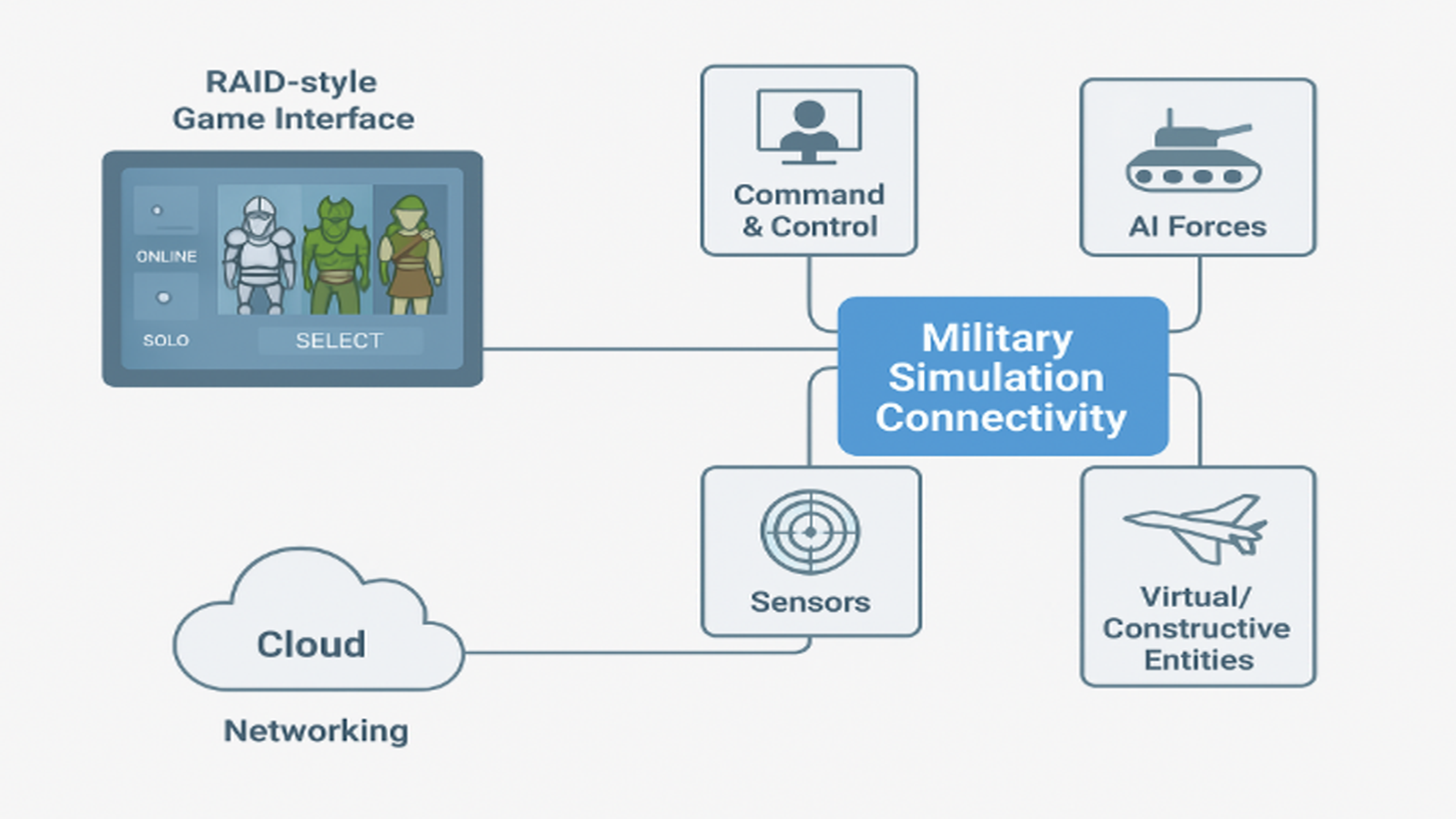
While RAID: Shadow Legends itself is a fantasy RPG, many of the underlying technologies — network architecture, rendering systems, synchronization mechanisms, and UI frameworks — are directly relevant to modern military simulation platforms.
The goal wouldn’t be to use the game itself, but rather to adapt its technologies (engine design, networking model, AI control, etc.) to create connected, high-fidelity military training systems.
From Game Systems to Military Connectivity
| Component | In Commercial Game | In Military Simulation |
|---|---|---|
| Network Architecture | Client-server or P2P synchronization of players | Distributed network with low-latency tactical links, redundancy, and deterministic synchronization |
| Server Infrastructure | Cloud clusters for matchmaking and multiplayer | Geo-distributed simulation servers connected via secure military networks or satellite links |
| Modular System Design | Independent quests, character modules | Modular battle spaces: command modules, sensor feeds, AI force controllers |
| Graphics & Rendering | Character visuals, cinematic environments | Real-world terrain, satellite data, thermal & radar visualization layers |
| Data Interfaces | Internal game APIs for stats, states | Open interoperability standards like HLA (High Level Architecture) or DIS (Distributed Interactive Simulation) |
| Security & Access | Account logins and anti-cheat | Encrypted comms, multi-level clearance, zero-trust network models |
| Scalability & Updates | DLCs, online patches | Real-time scenario updates, adaptive mission injection, integration with C2 systems |
“RAID-Style” Interface for Military Simulation
Imagine combining a RAID-like game interface with a networked simulation backbone:
- Unit/Class Selection Interface
Just like selecting characters in RAID, soldiers choose their roles — infantry, tank operator, drone pilot — before entering the simulation. - Massively Connected Battlefield
Dozens of participants join the same digital environment, each controlling their own assets in sync with real-time command feeds. - AI Forces and Behaviors
The “enemy monsters” become AI-controlled hostile forces that react dynamically to player (trainee) decisions. - Sensor and Data Feeds
Real-time drone or satellite imagery is overlaid on the game map — rendered inside the engine’s 3D environment. - Multi-Tier Networking
- Local link: On-site training facility
- Tactical link: Field-deployed units or live exercises
- Cloud link: Command centers, after-action review, or AI analysis nodes
- Synchronization & Time Management
Games tolerate some delay; military systems don’t.
Simulations must ensure deterministic timing, event recovery, and packet re-sync to maintain accuracy.
Tech Stack That Bridges Both Worlds
| Category | Example Technology |
|---|---|
| Game Engine | Unreal Engine 5, Unity, CryEngine (used for serious simulations) |
| Networking Protocols | HLA, DIS, WebRTC (for real-time sync) |
| Visualization | NVIDIA Omniverse, Cesium for 3D geospatial rendering |
| AI Simulation | Reinforcement Learning agents for enemy behavior modeling |
| Data Backbone | Secure cloud or edge computing clusters |
| Interface Layer | VR/AR headsets, command dashboards, tactical HUDs |
Broader Applications (Dual-Use Potential)
Military-grade connectivity and simulation tech based on commercial game engines are also used for:
- Disaster response training
- Autonomous vehicle coordination
- Energy and industrial safety simulations
- Smart city crisis management
Socko/Ghost