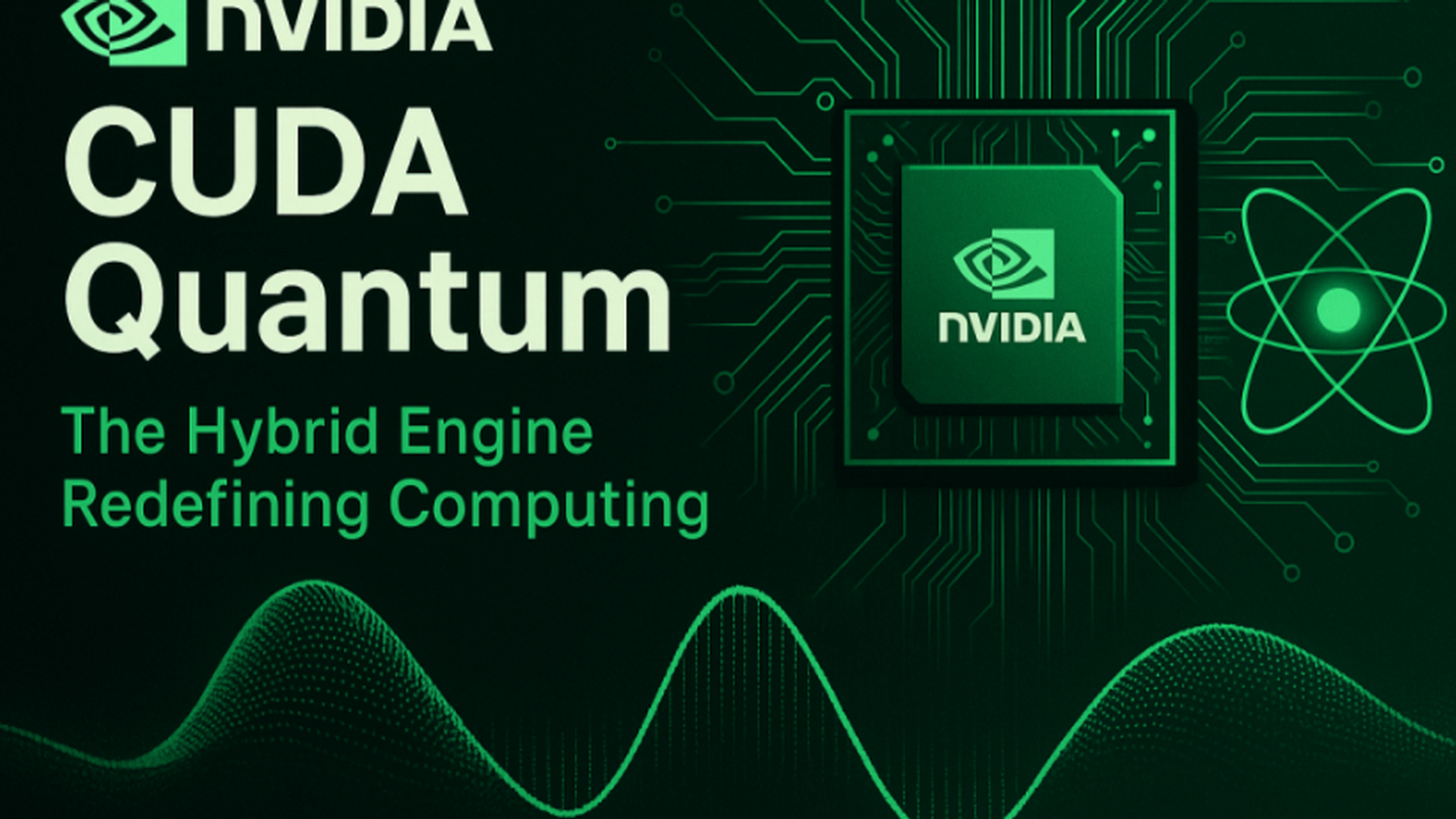
NVIDIA CUDA and the Quantum Frontier:
How GPU Acceleration Is Shaping the Next Era of Computing: Insights & Market Intelligence Feature Analysis
1. Introduction: A New Computational Threshold
For nearly two decades, NVIDIA’s CUDA architecture has been the silent engine powering breakthroughs—from deep learning models and autonomous systems to real-time simulation and robotics.
But in 2025, CUDA’s role is expanding beyond GPU acceleration alone.
It is becoming the on-ramp to quantum computing.
The convergence of GPU-accelerated classical systems and quantum processors is no longer theoretical; it is emerging through NVIDIA’s CUDA-Quantum platform, formerly known as QODA.
This hybrid model is redefining what “computing power” means.
2. Why CUDA Matters in the Quantum Era
CUDA’s continued dominance stems from three pillars:
1) Unified Developer Environment
Developers who already write CUDA kernels can now extend workflows into quantum circuits without learning an entirely new paradigm.
2) Hybrid Execution (GPU + QPU)
Quantum Processing Units (QPUs) excel at superposition and entanglement tasks,
while GPUs dominate linear algebra and large-scale simulation.
CUDA-Quantum orchestrates both.
3) Scalable Simulation Before Hardware Matures
Because quantum hardware is still noisy and limited,
GPU-accelerated simulation becomes essential—allowing enterprises to build quantum algorithms before QPUs reach scale.
3. Key Technical Advantages
3.1 CUDA-Quantum Programming Model
Developers can:
- Write quantum kernels in C++ or Python
- Run them on simulators (NVIDIA GPUs)
- Deploy the same code on real quantum hardware (IonQ, Quantinuum, Rigetti, etc.)
This bridges the gap between R&D and production.
3.2 GPU-Accelerated Quantum Simulation
Quantum systems grow exponentially in complexity.
A 40-qubit system requires more than 1 trillion complex amplitudes.
NVIDIA’s cuQuantum libraries allow:
- Dense and sparse matrix simulation
- Tensor-network simulation
- State vector evolution
- Quantum error correction modeling
This gives companies production-grade quantum R&D today, instead of waiting for hardware
4. Real-World Applications: Where Business Meets Quantum
1) Drug Discovery & Molecular Dynamics
GPUs handle molecular modeling,
QPUs explore quantum energy states.
Outcome: faster protein-folding, material discovery, and docking analysis.
2) Financial Risk Modeling
Hybrid Monte Carlo + quantum optimization unlocks:
- Portfolio optimization
- Derivative pricing
- Risk scenario generation
- Cryptographic resilience testing
3) Defense & Secure Communications
Relevant for SockoPower’s Defense Insights segment:
- Quantum-resistant encryption
- Quantum radar simulation
- Drone swarm optimization
- Nuclear material detection modeling
NVIDIA’s simulation architecture accelerat
4) AI Acceleration Itself
Ironically, quantum computing won’t replace AI—
it will accelerate the accelerators.
Quantum-inspired algorithms improve:
- Transformer efficiency
- Sparse modeling
- Reinforcement learning search
- Multi-agent simulation
CUDA makes AI-Quantum integration natural.
5. Market Intelligence: Strategic Outlook for 2025–2030
5.1 Winners in the Hybrid Era
NVIDIA
Controls the unified development stack (CUDA).
This effectively locks in the next decade of AI + quantum software.
IonQ / Quantinuum / Rigetti
Quantum hardware vendors benefit from CUDA-Quantum compatibility.
Defense & Aerospace Integrators
Raytheon, Lockheed Martin, and DARPA programs are accelerating hybrid quantum simulations.
5.2 Enterprise Adoption Timeline
| Year | Development Stage | Industry Activities |
|---|---|---|
| 2025 | Early Hybrid R&D | Simulation-first workflows |
| 2027 | Applied Quantum | Optimization & logistics use cases |
| 2030 | Quantum Advantage | Sector-specific deployment |
By 2030, hybrid AI+Quantum systems will replace 5–15% of HPC workloads.
5.3 Risks & Bottlenecks
- QPU hardware still noisy
- High energy costs for GPU clusters
- Talent shortage in quantum engineering
- Standardization fragmentation
- Security concerns around post-quantum cryptography
These are manageable but real.
6. Ethical & Humanistic Considerations
NVIDIA’s roadmap raises a critical question:
Does more computational power automatically empower humanity?
Not necessarily.
Quantum-accelerated AI must be governed with:
✅ Transparency
✅ Safety alignment
✅ Energy responsibility
✅ Defense ethics
A system powerful enough to design new materials can also design new threats.
SockoPower’s mission—linking power with purpose—becomes essential here.
7. Conclusion: CUDA as the Bridge to the Quantum Future
Quantum computing will not replace classical systems.
Instead: CUDA becomes the bridge.
GPU clusters become the “training wheels” for quantum acceleration.
Enterprises that adopt hybrid workflows early gain:
- faster simulation
- lower R&D risk
- better optimization
- long-term computational independence
This is not just a hardware revolution—
it is a paradigm shift in how intelligence is computed.