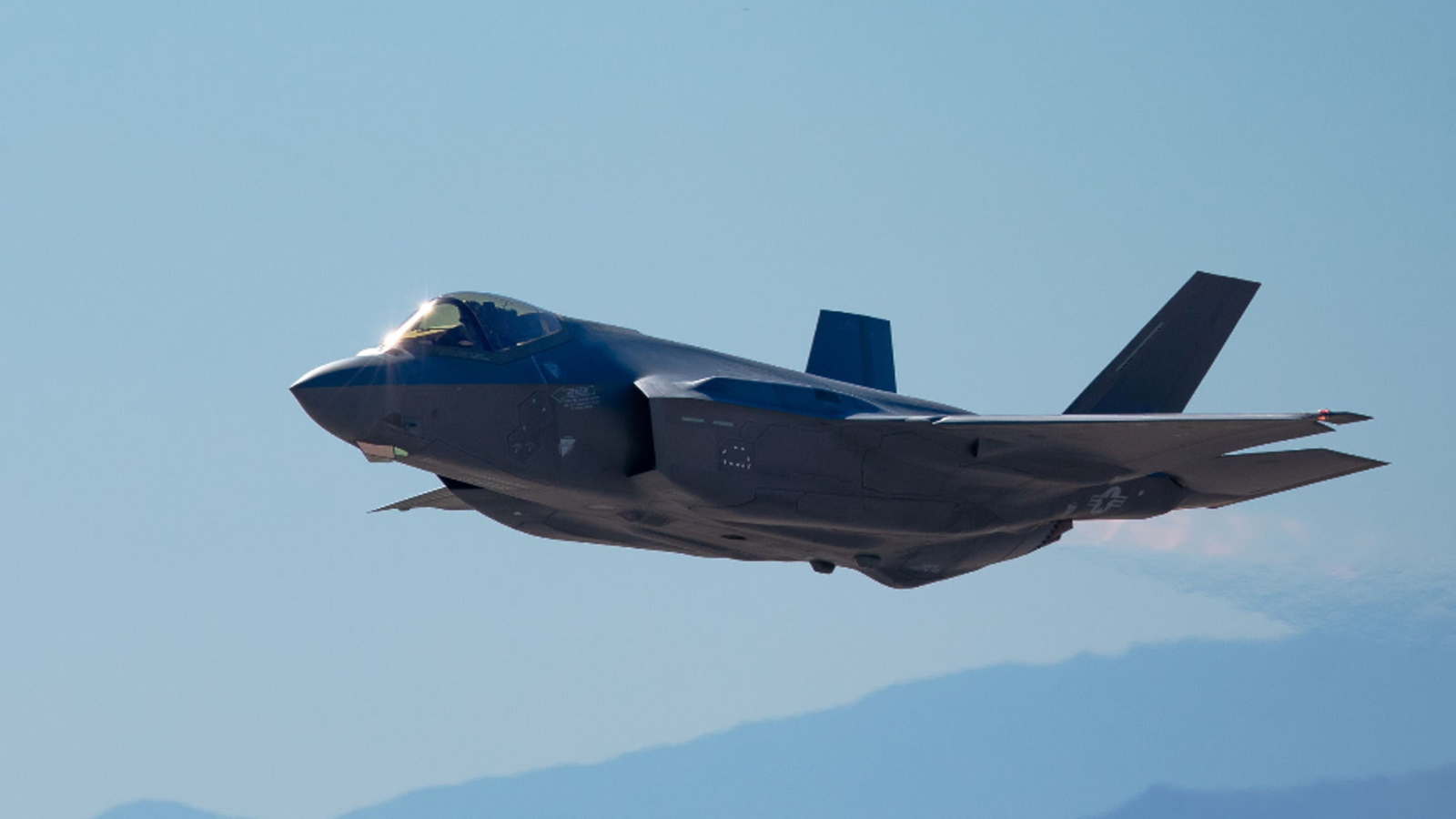
The F-35 Lightning II is a fifth-generation multirole fighter jet, notable for combining advanced stealth, supersonic speed, and a highly integrated sensor package.1
Here are the high-tech specifications for the primary variant, the F-35A (Conventional Takeoff and Landing – CTOL), along with its revolutionary features:
F-35A Lightning II Key Specifications
| Category | Specification (F-35A) | Note |
| Generation | 5th Generation Fighter | Combines stealth, speed, sensor fusion, and network-enabled operations. |
| Max Speed | Mach 1.6 (Approx. 1,200 mph) | Achieved even with a full internal weapons load. |
| Max g-rating | 9.0 g | High maneuverability. |
| Engine | Pratt & Whitney F135-PW-100 | World’s most powerful fighter engine, producing up to 40,000 lbs of maximum thrust. |
| Combat Radius | > 590 nautical miles (> 1,093 km) | Range with internal fuel. |
| Weapons Payload | 18,000 lbs (8,160 kg) total | Internal carriage for stealth, plus external hardpoints for “beast mode.” |
| Internal Stealth Armament | 4 internal hardpoints typically carrying: 2 | Maintains a low observable profile. |
| Gun | Internal 25mm GAU-22/A cannon |
High-Tech Features & Avionics (The Core of its 5th Gen Capability)
The F-35 is often referred to as the “quarterback of the skies” because its technology is focused on information superiority and sensor fusion.2
1. Advanced Stealth (Low Observability – LO)3
- Design Shaping: The airframe uses specific geometric shapes and aligned edges to deflect radar energy away from the source.4
- Radar Absorbent Material (RAM): Special coatings on the skin further reduce and absorb radar signals.5
- Internal Carriage: Weapons and fuel are carried internally to maintain a very low Radar Cross Section (RCS), allowing it to operate deep in contested airspace.6
2. Sensor Fusion
The F-35 automatically merges data from multiple, sophisticated sensors to create a single, unified, and real-time picture of the battlespace for the pilot.7
- AN/APG-81 Active Electronically Scanned Array (AESA) Radar: Provides superior long-range detection, tracking, and targeting of air and ground threats.8
- AN/AAQ-37 Distributed Aperture System (DAS): Consists of six infrared cameras mounted around the aircraft, providing the pilot with a 360-degree sphere of situational awareness for missile warning and navigation (the pilot can “see through” the floor of the cockpit).9
- Electro-Optical Targeting System (EOTS): A stealthy, integrated sensor under the nose that provides long-range air-to-air and air-to-ground precision targeting, infrared search and track (IRST), and reconnaissance capabilities.10
3. Pilot Interface (The Helmet)
- Helmet-Mounted Display System (HMDS): This replaces a traditional Head-Up Display (HUD).11 All flight, sensor, and targeting information is projected directly onto the pilot’s visor.
- “See-Through” Capability: The HMDS uses the DAS data to project an image onto the visor, allowing the pilot to look down, or behind them, and literally see the outside world as if the airframe weren’t there.12
4. Connectivity & Electronic Warfare
- Integrated Core Processor (ICP): Acts as the “brain” of the aircraft, processing massive amounts of data from all sensors for communications, electronic warfare, and targeting.13
- Multifunction Advanced Data Link (MADL): A secure, low-probability-of-intercept/low-probability-of-detection (LPI/LPD) data link that allows F-35s to share their fused combat picture with other F-35s while maintaining stealth.
- AN/ASQ-239 Electronic Warfare (EW) System: Provides advanced capabilities to locate, track, and jam enemy radar systems and disrupt attacks.14
Deployment of F-35 fighter jets to South Korea
The deployment of F-35 fighter jets to South Korea involves both temporary rotational deployments by the U.S. and the Republic of Korea Air Force (ROKAF) operating its own fleet.1
U.S. F-35 Deployments and Future Plans:
- Temporary/Rotational Deployments: The U.S. military (USAF and USMC) regularly deploys F-35 variants to the Korean Peninsula, often to participate in major combined exercises like Ulchi Freedom Shield (UFS) and Freedom Shield.2 These are temporary deployments aimed at enhancing combined readiness and deterrence.3
- Consideration for Permanent Deployment: There are reports and discussions about the U.S. military considering the permanent deployment of a squadron (around 20 aircraft) of F-35As to Kunsan Air Base in South Korea.4
- This potential move appears linked to a wider U.S. Air Force reorganization that involves consolidating its F-16 fighters at Osan Air Base.5
- U.S. officials have not officially confirmed a final decision on permanent F-35 basing.6
- If realized, this would mark the first permanent squadron-level deployment of the F-35 in South Korea and would significantly bolster U.S. air assets on the peninsula.7
Republic of Korea Air Force (ROKAF) F-35s:
- Current Fleet: South Korea operates its own fleet of F-35A stealth fighters (currently 39 aircraft, with one retired).8
- Base: These ROKAF F-35As are permanently based at Cheongju Air Base.9
- Future Acquisition: South Korea has announced plans to acquire an additional 20 F-35As, which are expected to begin operations around 2027.10
- Joint Operations: There is consideration for the ROKAF to station some of its incoming F-35As at Kunsan Air Base, which would allow U.S. and ROKAF F-35s to operate jointly from the same location.11
Socko/Ghost